About Citrus maxima (Burm.) Merr.
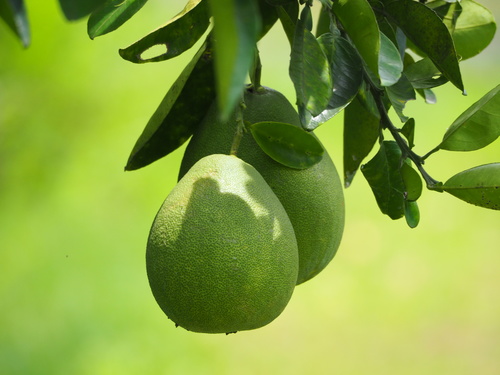
This species, with the scientific name Citrus maxima (Burm.) Merr., is commonly known as pomelo. Pomelo trees grow 5–15 meters (16–50 feet) tall, with a typically crooked trunk that is 10–30 centimeters (4–12 inches) thick, and low, irregularly arranged hanging branches. The leaf stalks (petioles) have distinct wings. Leaves grow in an alternate arrangement, are shaped ovate or elliptic, and measure 5–20 cm (2–8 in) long; they have a leathery texture, are dull green on the upper surface, and covered in hairs on the lower surface. Flowers are either single or borne in clusters, are fragrant, and yellow-white in color. Pomelo fruit is large, with a diameter of 10–30 cm (4–12 in), and a round or somewhat pear-shaped form. Fruit weight ranges from 0.26–1.95 kilograms (0.6–4.3 pounds) depending on the cultivar. It has a thicker rind than grapefruit, and is divided into 11 to 18 segments. Its flesh is less acidic than grapefruit flesh. There are at least 60 distinct pomelo cultivars. Most pomelo fruits contain a small number of relatively large seeds, though some varieties produce many seeds. Pomelo characteristics vary widely across South Asia. Pomelo is native to Southeast Asia and all of Malaysia. The tree was likely introduced to China around 100 BCE, and is now heavily cultivated in Southern China. Pomelo seeds were first brought to the Americas in the late 1600s. For cultivation, pomelo seeds are monoembryonic, meaning they produce seedlings that inherit genes from both parents, so they do not grow true to the parent type. However, resulting seedlings are usually fairly similar to the parent tree they come from, so pomelos are typically grown from seed throughout Asia. Seeds can be stored for 80 days at 5 °C (41 °F) with moderate relative humidity. Pomelos can also be propagated vegetatively via air-layering, cuttings, grafting, shield budding, or tissue culture.