About Citrus L.
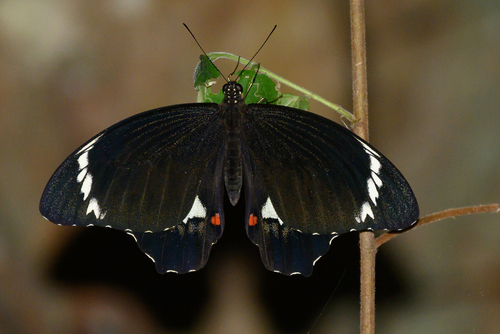
This description actually refers to Papilio aegeus, not the plant genus Citrus L. Both male and female Papilio aegeus have black forewings marked with a white stripe; female forewings have more white overall. Their hindwings are also black, with a broad white band across the middle. For hindwing markings near the edge, females have chains of red to orange and blue crescents that are not present in males. Underside wing markings match the markings on the upper side of the wings. The body of this butterfly is black. Females have a wingspan of about 140 millimetres (5.5 in), while males have a wingspan of about 120 millimetres (4.7 in), making the species overall quite large; it is the largest butterfly commonly seen in at least part of its range. Despite being a swallowtail butterfly, a group named for the distinctive tails on their hindwings, this species completely lacks this characteristic tail. Karl Jordan described forma of this species on pages 65–67 in Seitz. Papilio aegeus can be found in every Australian state except Tasmania. It is generally found across eastern Australia, with well established colonies in the Albany region of Western Australia; some people promote controlled propagation of its eggs and caterpillars in Western Australia. It is especially common in Queensland, and is the largest butterfly commonly found in Brisbane, where many citrus trees grow — citrus trees are the food source for this butterfly's larvae. During summer, the species' distribution temporarily extends to Victoria. In New South Wales, adults are more abundant during late summer and autumn. The subspecies P. a. ormenus is found on Papua New Guinea and Thursday Island. A distinguishing feature between males of P. a. aegeus and males of P. a. ormenus is that P. a. aegeus males have a red spot on the upper side of each hindwing, a spot that is absent in P. a. ormenus males. Additional subspecies occur on islands in the Banda Sea and the Bismarck Sea.