About Citrullus amarus Schrad.
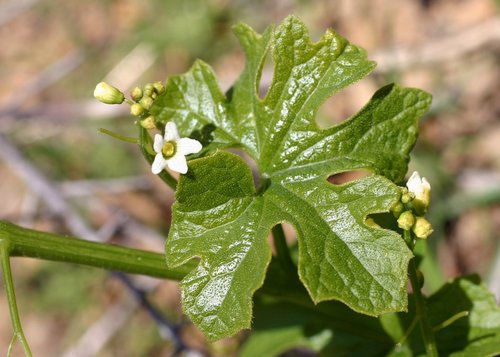
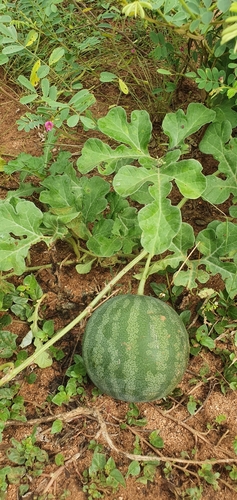
The fruit of Citrullus amarus Schrad. (commonly called citron melon) resembles modern domesticated watermelons, but is smaller and more spherical. Its flesh is whiter, denser, and has a much stronger flavor, similar to the region of a domesticated watermelon where the red flesh transitions to the white rind. While some people eat this melon raw, it is most often cooked or otherwise prepared. Early-growth citron melon leaves are palmate, and become deeply lobed as the plant matures. The leaves have a rough texture and prominent white venation. The plant produces solitary yellow flowers, with petals measuring around 2–10 millimeters, borne scattered along the vine. Flowers develop into many-seeded fruits with a variegated pattern of light and dark green. Citrullus amarus is native to Africa, most likely the Kalahari Desert, where it still grows abundantly today. The timing and location of its initial domestication remain unknown, but it was cultivated in ancient Egypt at least four thousand years ago. It is grown for food across Africa, particularly in dry or desert regions including South Africa. In some areas, it serves as a source of water during dry seasons. Among the Xhosa people of South Africa, it is commonly consumed as intyabontyi, eaten either raw or cooked. Today, it is found not only in Africa but also cultivated in other regions. In the southern plains states of the United States, it is known as both pie melon and citron melon. It has become an invasive wild species in western Mexico.