About Citronella mucronata (Ruiz & Pav.) D.Don
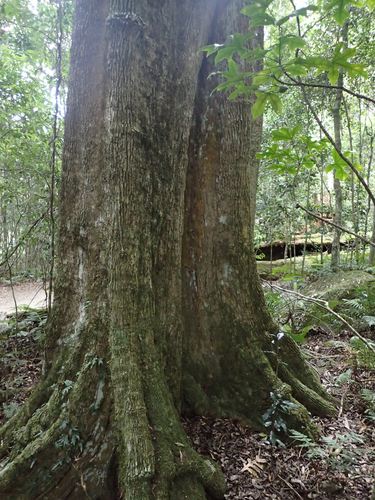
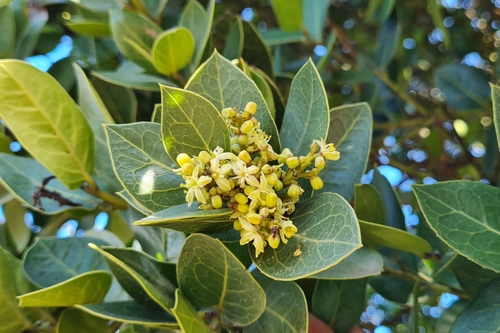
Citronella mucronata (Ruiz & Pav.) D.Don is a tree that can reach up to 10 m (30 ft) in height and 1 m (3 ft) in trunk diameter. Its bark is dark gray and rough. It has alternate, leathery leaves with either entire or toothed margins; leaves are ovate or oblong in shape, with an acute apex that ends in a sharp point called a mucro. Mature leaves measure 4.5–6 cm (1.8–2.4 in) long and 2.5–4 cm (0.98–1.6 in) wide. Leaves have domatia in the axils of their side veins, and the veins themselves are yellow. The upper leaf surface is glossy green, while the underside is paler, and leaves are attached to stems by small petioles.
The flowers are hermaphrodite, whitish yellow, and arranged in terminal panicles that are 4–8 cm (1.6–3.1 in) long. Its calyx is formed of 5 sepals, and the corolla has 5 free petals. The fruit is a spherical drupe, about 1–1.2 cm (0.39–0.47 in) in diameter, that turns purple when fully mature.
This species is native to the Mediterranean climate Chilean matorral ecoregion. It grows in a discontinuous range from Limari Province (at 30°40'S) to Osorno Province (at 40°30'S), occurring at elevations between 15 and 1,050 meters (49 and 3,445 ft). It is common in the Chilean Coastal Range, and less common further east in the foothills of the Andes. It most often grows in sclerophyllous forest, and is most frequent in the Roble–Hualo forest type, where it can grow alongside Nothofagus dombeyi and Nothofagus alpina depending on latitude. In northern coastal habitats, it is often associated with Aextoxicon punctatum, Beilschmiedia miersii, Cryptocarya alba, and Schinus latifolia. In Los Bellotos del Melado National Reserve in the Andes, it grows with Beilschmiedia berteroana, Cryptocarya alba, Nothofagus glauca, and Quillaja saponaria.