About Citronella moorei (F.Muell. ex Benth.) R.A.Howard
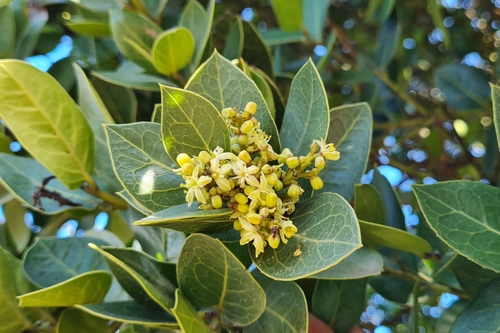
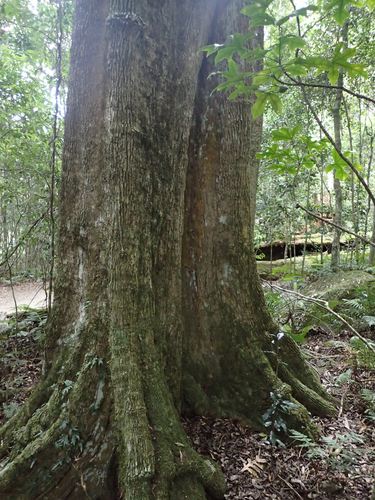
Citronella moorei is a large tree that reaches 50 metres in height and 2 metres in trunk diameter. It has a dense, dark green crown. Its bark is fawn or greyish, fissured, and corky. The trunk is prominently and irregularly channelled, twisting or fluted, and is often leaning and crooked. Round trunks only occur on very young trees, and are rarely seen in mature specimens. Branchlets are moderately slender, green, and smooth, while young shoots are covered in fine down. The leaves are alternate, simple, 5 to 10 cm long and 4 to 6 cm broad. They do not have wavy edges, and taper to a blunt point. When leaves fall to the forest floor, old leaves turn black. Venation is prominent on both leaf surfaces. The midrib and four to six lateral veins are raised, conspicuous, and paler on the underside of the leaf. C. moorei is dioecious, meaning male and female flowers grow on separate individual plants. Flowering occurs between May and September, and produces creamy green flowers arranged in narrow panicles. The fruit is a black drupe, around 2 cm long. The outer layer of the fruit is moist and fleshy, and the inner part is hard. Fruits ripen between December and June, and are eaten by the green catbird, topknot pigeon, and wompoo fruit dove. For propagation, it is advised to remove the fleshy aril from the seed. Germination of sown fresh seed is slow; it begins after approximately six months, completes after 8 to 14 months, and has a 100% success rate. This species grows on volcanic soils or rich alluvial soils in tropical, subtropical, and warm temperate rainforests, and is common in sheltered valleys and slopes. Its natural range extends from the Clyde River, New South Wales (35° S) north to Mossman, Queensland (16° S) in tropical Australia.