About Citheronia regalis Fabricius, 1793
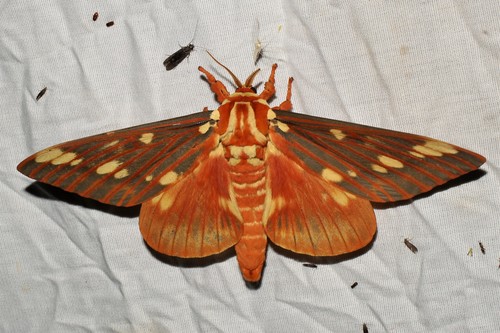
Citheronia regalis, commonly known as the regal moth or royal walnut moth, is a North American moth belonging to the family Saturniidae. Its caterpillars are called hickory horned devils. Adult regal moths have a wingspan between 3.75 and 6.1 inches (9.5 to 15.5 cm), and the species was first formally described by Johan Christian Fabricius in 1793.
This species is common in the American Deep South, and becomes rarer and more sporadic as its range extends northward. It occurs throughout deciduous forests in the United States, ranging from Missouri, Pennsylvania to Massachusetts, and southward from Texas to central Florida. Historically, it was recorded across all of New England, but it declined in the Atlantic Northeast during the mid-20th century. Excluding sparse modern records from New York, the species has a stable range in mid-Atlantic states and southern Appalachia, starting from southern New Jersey west through the Ohio Valley, the edge of Great Plains states, and south to East Texas. It is listed as a species of special concern and is believed to be extirpated from the U.S. state of Connecticut.
Citheronia regalis is the largest moth by mass found in latitudes north of Mexico, with equally large, distinctive larvae and substantial pupae. Its life cycle follows the typical pattern for Saturniidae species and the subfamily Ceratocampinae: instead of spinning a cocoon, it burrows into the ground to pupate inside an earthen chamber. Its eggs are yellowish, ovular, and 2 mm in diameter. Eggs are laid either singly or in groups of up to four on the upper surface of host plant leaves, with a preference for nut trees in the genera Juglans (walnuts) and Carya (hickories). Regional host preferences exist: sweet gum and persimmon are used in the south, and sumacs are used where walnuts and hickories are not available. Later-stage larvae are solitary, and rarely occur in large enough numbers to cause defoliation; however, a single ravenous fifth-instar larva can strip all leaves from several branches. Recorded host plants include Carya (including Carya illinoensis), Juglans cinerea, Liquidambar styraciflua, Diospyros virginiana, Rhus, Gossypium, and others. Adult regal moths do not feed.
Eggs hatch 7 to 10 days after being laid, producing small yellow larvae that darken quickly. In early stages, caterpillars are solitary nocturnal feeders, and curl into a J-shape during the day to resemble two-toned bird droppings. As caterpillars mature, they begin feeding during the day. They molt four times, and each instar has a different appearance. In the fifth and final instar, they turn bright green with large, black-tipped red horns, which gives them their common name hickory horned devils. They feed heavily on their host plant for 37 to 42 days, and can grow up to 15 centimetres (5.9 in) long. Their intimidating appearance is only a bluff: while the spines are prickly, they do not sting, and the larvae are harmless, and among the easier saturniidae to handle.
Just before pupation, the larva expels its gut and changes color from green to turquoise, and the skin of the fully fed larva becomes stretched, shiny and tight. The larva then crawls down the host plant, burrows into the dirt, and pupates in a well-formed chamber 5 to 6 inches deep. Pupae are dark brown to black, and have a relatively short cremaster. Some pupae overwinter for two seasons, which may be an adaptation to variable and adverse conditions like fires and flooding, or a way to maintain genetic diversity across generations.
When adult moths eclose (emerge), they pump hemolymph (fluid) into their wings to extend them. Females release pheromones, which males can detect using their large, plumose antennae. Males may fly miles to reach a receptive female. After mating, the female spends most of her remaining life laying eggs, while the male may mate several more times. Like other moths in Saturniidae, adult regal moths have vestigial mouthparts, meaning their mouthparts are reduced in size. Because of this, they cannot eat, and only live for about a week as adults.
There is one generation of Citheronia regalis across its entire range, though in the Deep South adults have been recorded throughout the longer growing season. Typically, C. regalis is a midsummer moth, active on the wing from late June through August, with larvae reaching peak numbers from August through October. Emergence follows a distinct bell curve, with peak emergence coinciding with the first period of humid summer weather, which appears to synchronize emergences.