About Citharichthys stigmaeus Jordan & Gilbert, 1882
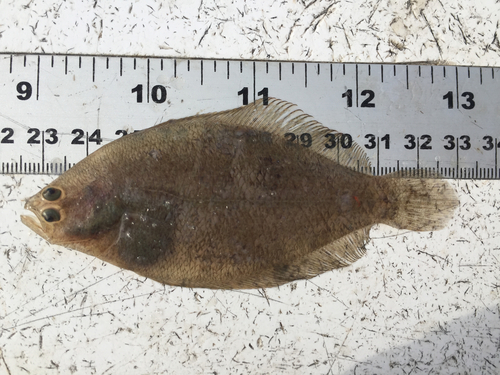
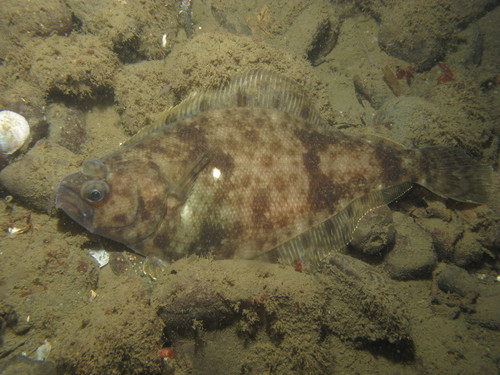
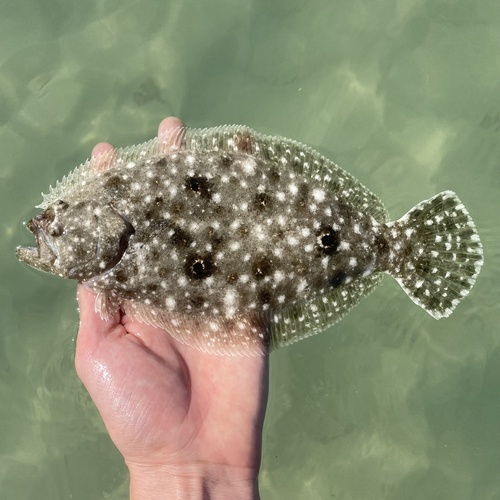
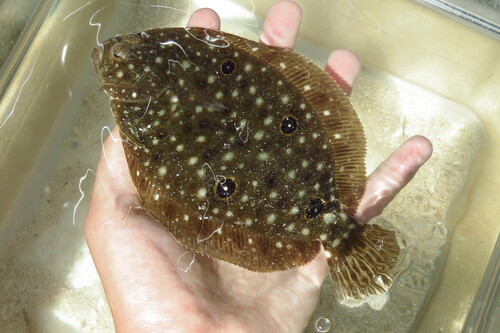
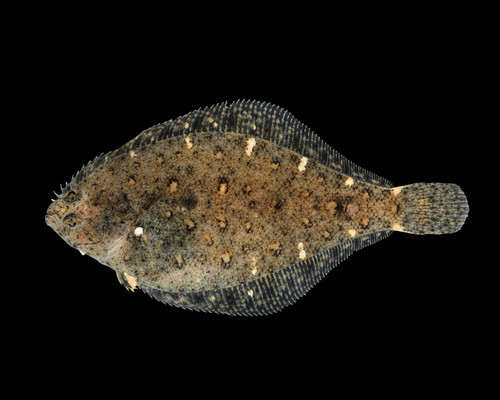
This species, the speckled sanddab Citharichthys stigmaeus, is a much smaller relative of the Pacific sanddab Citharichthys sordidus, reaching a maximum total length of 17 centimetres (6.7 inches). It inhabits sandy bottoms, ranging from near-shore areas out to depths of 350 metres (1,150 feet). Its upper body is dull brown or tan, while its underside is white or pale brown. Males are typically mottled with orange spots. It can be easily confused with the English sole, which shares a similar compressed body shape and body proportions, including caudal fin length. The key difference between the speckled sanddab and the English sole is in their mouth and jaw structures, which also leads to slightly different diets. Like other Citharichthys species, the speckled sanddab has both eyes positioned on the left side of its body, with symmetrical jaws and asymmetrical pelvic fins. Unlike other similar Citharichthys species, the speckled sanddab does not develop rays during its developmental stages. One of the speckled sanddab’s main defensive adaptations is the ability to camouflage itself by matching the appearance of the surface it rests on. This allows it to avoid detection in murky benthic environments by blending in with surrounding sediment. It has a range of mostly evasive anti-predator responses, and becomes more cautious around predation and feeding when predators are present. It adjusts its posture and movement based on whether food or predator cues are present. The speckled sanddab may be one of the more resilient flatfish species, according to a 2017 study that exposed the species to varying CO2 levels to measure their responses. The study found the species shows potential resilience to elevated CO2, and may be generally better suited to cope with ocean acidification. However, after exposure to high CO2 levels, the species was slower to successfully feed. Additional research indicates the speckled sanddab may be more sensitive than other California fish species to marine habitats with elevated sulfide concentrations. It cannot effectively detoxify sulfide through oxidation, which may correspond to the species occupying a smaller environmental niche.