About Cistus laurifolius L.
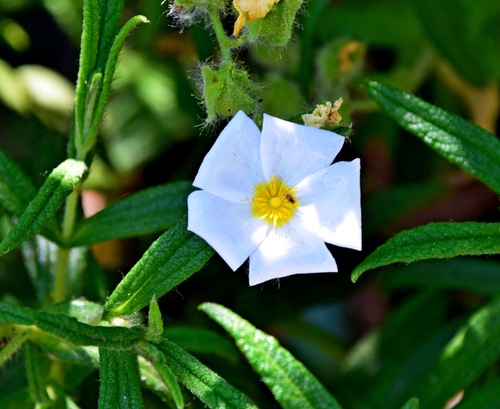
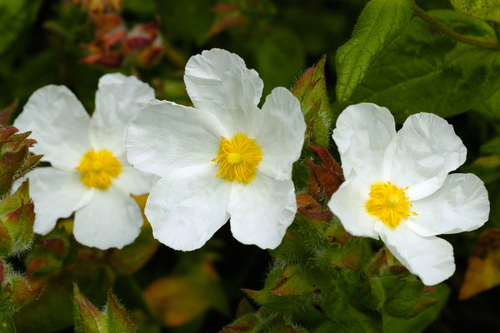
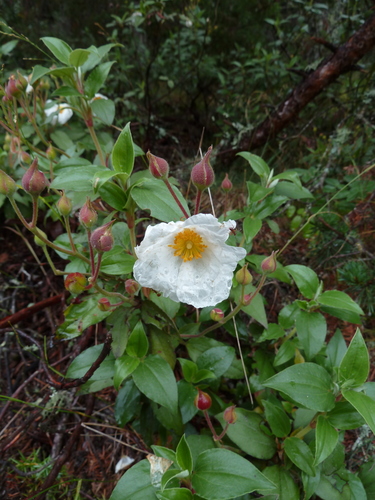
Cistus laurifolius L. grows 0.8–2 m (2 ft 7 in – 6 ft 7 in) tall. It has strong, erect branches with reddish bark that strips off easily in strips. Its leaves are larger than leaves of other Cistus species, growing up to 9 cm (4 in) long. The leaves are lanceolate and dark green, with a whitish underside covered in trichomes. Flowering occurs in late spring, from May to June, which is later than flowering for most other rockroses. It produces white flowers 4.5–5 cm in diameter, each with a yellow spot at the base of every petal. This species is widely cultivated in gardens, and has earned the Royal Horticultural Society's Award of Garden Merit. Cistus laurifolius has a disjunct natural distribution across the Mediterranean Basin. In the western part of its range it occurs in Morocco, Iberia (Portugal and Spain), where it avoids the wetter climate of northwest Iberia, as well as southern France, Corsica, and Tuscany, Italy. In the eastern part of its range it occurs in Greece and Anatolia. Following the overall warming of the atmosphere and the retreat of glacial ice, Tertiary-period surviving flora could not re-establish their former ranges across southern Europe, as the new post-glacial climate was drier than the climate of the Tertiary. The original tropical European flora evolved into the modern Mediterranean sclerophyll flora. The distribution of some surviving species including Cistus laurifolius shifted to wetter areas, particularly mountains. As a result, C. laurifolius is called mountain rockrose in Spanish across its distribution range, though it grows at sea level in the moister coastal west and northwest Iberian Peninsula. Cistus shrubland that includes C. laurifolius resprouts after fire, and its seeds germinate after fire events.