About Cistanche phelypaea (L.) Cout.
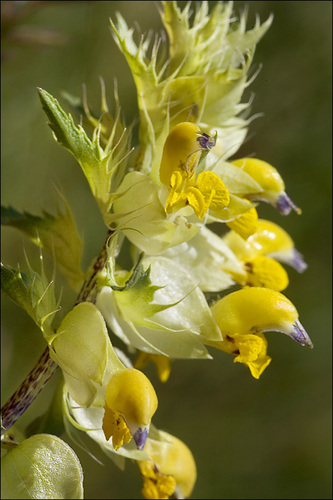
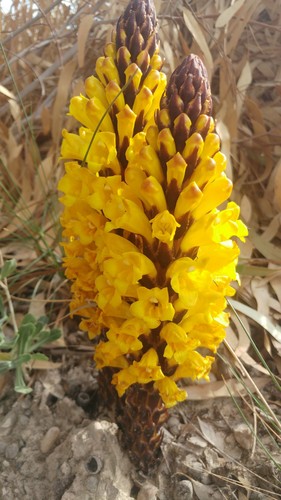
Cistanche phelypaea (L.) Cout. is an obligate parasitic plant that produces no chlorophyll. It grows stout, fleshy flowering stems that reach 20–50 cm (7.9–19.7 in) tall, emerging from a typically swollen base. The stems are glabrous, and range in color from yellow to purple-gray. Its leaves are ovate-lanceolate, obtuse, glabrous, and usually brown. The inflorescence is dense and roughly cylindrical. The flower crown is broadly campanulate-obconic, strongly curved, glabrous, and bright yellow, sometimes with a light purple tint, and it has white stigmatic lobes. Chromosome counts for this species are 2n = 40 and n = 20. It parasitizes the roots of bushes in the plant family Chenopodiaceae. The plant is used as a food source, and is eaten in a similar manner to asparagus. Cistanche phelypaea grows in saline, sandy habitats, mostly in coastal zones but also at inland sites, ranging from sea level up to 600 m (2,000 ft) in altitude. Its native distribution includes West Asia (Syria, Saudi Arabia, Qatar, Oman, Yemen, Soqotra), Africa (Djibouti, Ethiopia, Eritrea, Sudan, Egypt, Chad, Libya, Niger, Algeria, Tunisia, Mali, Senegal, Mauritania, Western Sahara, Morocco), Southern Europe (Cyprus, Crete, Spain, Portugal), and Macaronesia (Cape Verde, Canary Islands, Savage Islands, Madeira). It has also been introduced to Mozambique and France.