About Cissopis leverianus (J.F.Gmelin, 1788)
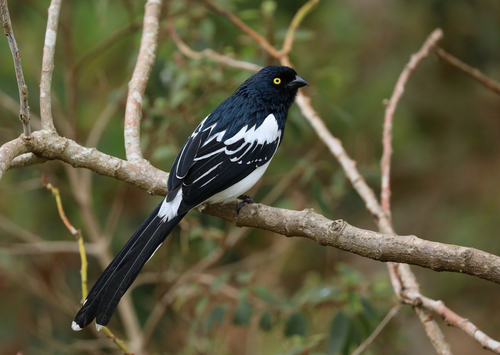
The magpie tanager (Cissopis leverianus) is a South American tanager species, and it is the only member of the monotypic genus Cissopis. As its common name suggests, this blue-black and white species looks superficially similar to the European magpie. Its total length is 25–30 cm (9.8–11.8 in), and a large proportion of its total length is made up by its tail, making it the longest tanager species. It weighs between 69–76 g (2.4–2.7 oz). This species is widespread across South America east of the Andes, where it inhabits humid tropical and subtropical woodland, plantations, secondary growth, and parks. It is not found in drier regions like the Caatinga, nor in most of northeastern Brazil. In densely forested areas, it primarily lives in relatively open stretches, such as areas near major rivers. In these regions, it is expanding its range as deforestation opens up new suitable habitat. It is mostly restricted to lowlands, but can be found at altitudes up to 2,000 m (6,600 ft) on the eastern slopes of the Andes. It is common across most of its range, but less common in the Guianas. It typically forms noticeable, noisy pairs or groups of up to 10 individuals, and often joins mixed-species foraging flocks. It frequently bobs its long tail up and down. Its diet consists of seeds, fruits, and insects. It builds a cup-shaped nest lined with grass, leaves, or other plant material. Nests are placed low in trees near the ground, or in shrubs within dense vegetation. Clutches contain 2 reddish-brown eggs marked with brown spots. In captive settings, the incubation period lasts 12–13 days.