About Cissa hypoleuca Salvadori & Giglioli, 1885
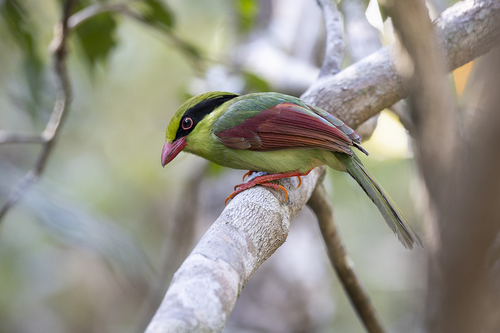
This small bird, Cissa hypoleuca, measures approximately 35 cm (14 in) in length. Like all other members of the Cissa genus, it has unique brightly fluorescent plumage. Most of its body is primarily green. Unlike other Cissa species, southern populations in Southeast Asia have yellow underbellies; only the Chinese population retains green underbellies matching other Cissa birds. A black band runs from the bird's bill, across its crimson eyes, and extends to the back of the head, forming a marking that resembles the mask of the popular movie character Zorro. It has long reddish-brown flight feathers, and both its bill and legs are bright red. Males and females are mostly similar in appearance. Juveniles have duller plumage than adult birds. Plumage can also become duller if the bird is exposed to excessive amounts of sunlight. The yellow-breasted magpie is native to Asia, where it occurs in China, Laos, Thailand, and Vietnam. It can live at altitudes up to 1,500 meters (4,900 ft), across a total range area of around 1,920,000 km² (740,000 sq mi). It is non-migratory and remains in its range year-round. It inhabits moist tropical and subtropical forests across its distribution. Its bright green plumage makes it easy to spot when moving between branches in foliage, so it is found mainly in forest tree canopies, where the green environment better camouflages its plumage and protects it from predators. The yellow-breasted magpie is carnivorous and eats a wide variety of prey, including small frogs, insects, snake eggs, lizard eggs, and nestlings. The insects it eats feed heavily on lutein-rich plants; lutein is a yellow carotenoid pigment that causes Cissa genus birds to develop bright green plumage rather than blue. Birds cannot produce lutein on their own, so malnourished birds that lack sufficient lutein develop blue plumage instead.