About Cissa chinensis (Boddaert, 1783)
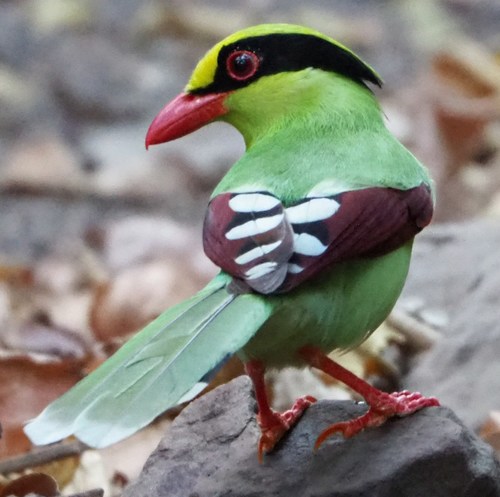
The common green magpie, Cissa chinensis, is a member of the crow family. It is roughly the size of the Eurasian jay, or slightly smaller. Wild common green magpies are typically a bright, lush green in color; this green often fades to turquoise in captivity or when the bird has a poor diet, because the green pigment is carotenoid-based. The underside of the bird is slightly lighter than the upperparts, and it has a thick black stripe that runs from the bill through the eyes to the nape. Compared to other members of its genus Cissa, the common green magpie has a quite long, white-tipped tail. The bird’s vivid red fleshy eye rims, bill, and legs contrast sharply with its other coloration, and its wings are a reddish maroon. This species occurs in a broad southeasterly band ranging from the lower Himalayas in northeastern India down through central Thailand, Malaysia, Sumatra, and northwestern Borneo. It inhabits evergreen forest (including bamboo forest), clearings, and scrub. Common green magpies forage for food both on the ground and in tree canopies. A very high percentage of their diet consists of animal prey, including countless invertebrates, small reptiles, small mammals, young birds, and eggs. They will also feed on flesh from recently killed carcasses. When feeding broods, they usually feed newborn young first. The common green magpie builds its nest in trees, large shrubs, and very often in tangled masses of climbing vines. A clutch typically contains 4 to 6 eggs. The species’ voice is quite varied, but it is often a harsh peep-peep. Common green magpies also frequently whistle and chatter.