About Cirsium waldsteinii Rouy
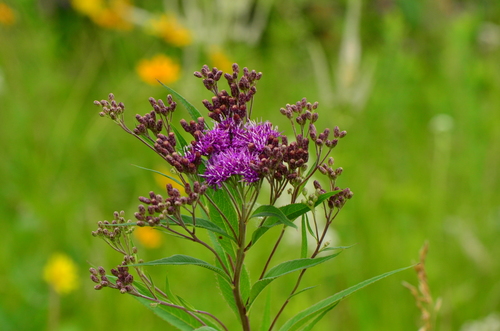
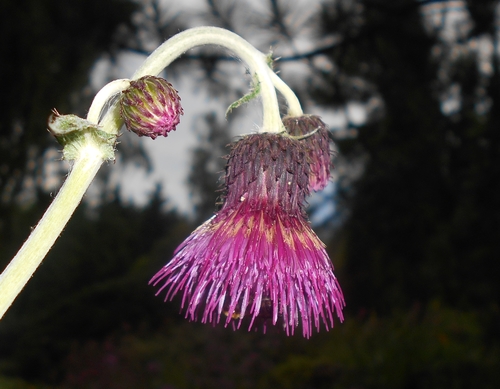
Cirsium waldsteinii Rouy has thick taproots with many branching rootlets. Mature plants reach 50 to 150 centimeters in height, sometimes growing as tall as 200 centimeters. Stems are unbranched or have only a few branches, and plants can produce up to 6 pedicels. Growth is erect, but stems curve downward just below the flower heads. Leaves grow along the entire length of the stem. For mature specimens, basal leaves measure 8.1 to 28.7 centimeters wide, with a length 1.3 to 2.8 centimeters greater than their width, falling most commonly between 9.0 and 26.1 centimeters wide and 1.4 to 2.2 centimeters longer than wide. Basal leaf shapes range from ovate to orbicular to deltate, with deltate shapes being especially common in younger leaves. Peduncular leaves are amplexicaul and often auriculate. These leaves have doubly serrate pinnate lobes, with small weak spines (up to 2 millimeters long) along the lobe edges. The upper leaf surface is pubescent, while the lower surface is covered in arachnoid-lanate fuzz. The species produces flower heads (capitula), each holding 3 to 8 individual flowers. When flowering, the involucre measures 15 to 23 millimeters in one dimension and 15 to 22 millimeters in the other, most commonly 17 to 23 millimeters by 15 to 22 millimeters. Individual involucral bracts flare outward from the flower bud and have distinct vittae. Outer bracts have a visible spine, while inner bracts do not. The whole involucre is greenish purple to brownish purple. The corolla length ranges from 14.5 to 23.1 millimeters, most commonly 15.3 to 21.9 millimeters. At full bloom, corollas are most often greyish violet, but can range from purple to greyish violet to darker shades; darker colours overlap in appearance with that of Cirsium greimleri. All colour descriptions are given following the Methuen colour system. As the flowers fade, corollas are most often deep magenta or greyish violet, and can also range from lighter to darker shades of greyish magenta. This species is strongly anemochorous. Its fruits contain achenes that measure 3.8 to 5.8 centimeters long, most commonly 4.2 to 5.3 centimeters. Each achene is attached to a pappus that measures 14.0 to 20.4 millimeters long, most commonly 14.3 to 19.8 millimeters. This species is found in the East and South Carpathians, and a complete distribution map was published in 2018. It is a subalpine species that prefers damp, shady locations. It is a calcifuge species, and grows on forest meadows, clearings, and forest edges. It can also grow above the treeline, among scrub vegetation, and on talus slopes. It is a perennial species. Flowering occurs from mid June to mid July; at more shaded or higher altitude sites, flowering may continue to late July or even September. Plants are gynodioecious. A notable unusual trait of this species is that female achenes are smaller than hermaphrodite achenes; this pattern is typically reversed in other species. This reversed pattern has been explained as compensation for the genetic disadvantage females have relative to hermaphrodites, and as a result of the absence of inbreeding depression. Suggested explanations for this unusual trait in both C. greimleri and C. waldsteinii include a larger number of achenes produced, higher germination rates, and lower infestation by achene predators such as tephritid flies and weevils. It is associated with low-density spruce forests.