About Cirsium vulgare (Savi) Ten.
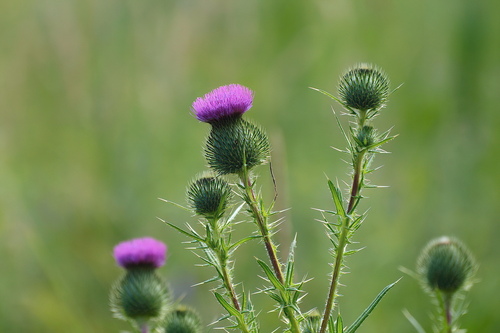
Cirsium vulgare (Savi) Ten. is a tall thistle, typically a biennial or short-lived monocarpic species. In its first year, it grows a leaf rosette and a taproot that can reach up to 70 cm (28 in) long. In the second year, and rarely in the third or fourth year, it produces a flowering stem between 1–1.5 m (3 ft 4 in – 4 ft 11 in) tall, though it can grow as tall as 1.8 metres (5 ft 11 in). Occasionally, it grows as an annual and flowers in its first year. Its stem is winged, with numerous longitudinal spine-tipped wings running along its full length. Its leaves are stoutly spined, grey-green, and deeply lobed. Basal leaves grow up to 30 centimetres (12 in) long, while smaller leaves grow on the upper section of the flower stem. The leaf lobes are spear-shaped, which is where the common English name of this plant comes from. The inflorescence has a diameter of 2.5–5 centimetres (0.98–1.97 in), and is pink-purple. All florets on this plant have the same form, with no division into disc and ray florets. Its seeds are 5 millimetres (0.20 in) long, with a downy pappus that helps with wind dispersal. As with other species in the genus Cirsium, and unlike species in the related genus Carduus, the pappus hairs are feathery with fine side hairs. Spear thistle is often a ruderal species that colonises bare, disturbed ground, and it also persists well on heavily grazed land because it is unpalatable to most grazing animals. Its proliferation increases in nitrogen-rich soils. The flowers are a rich nectar source, used by many pollinating insects including honey bees, wool-carder bees, and many butterflies. Goldfinches, linnets and greenfinches eat its seeds. Its seeds are dispersed by wind, mud, water, and possibly also by ants. They do not have significant long-term dormancy: most germinate soon after dispersal, and only a few can last up to four years in the soil seed bank. Seeds are also frequently spread by human activity such as movement of hay bales. The stems can be peeled to remove their spiny surfaces, then steamed or boiled. The tap roots can be eaten raw or cooked, but are only palatable on young thistles that have not yet flowered. Dried florets steeped in water are used in rural Italy to curdle goats' milk to prepare it for cheese making. In Iran, cleaned stems are used in the dish Khoresh-e-Kangar, which is thistle stem stew.