About Cirsium pitcheri (Torr. ex Eaton) Torr. & A.Gray
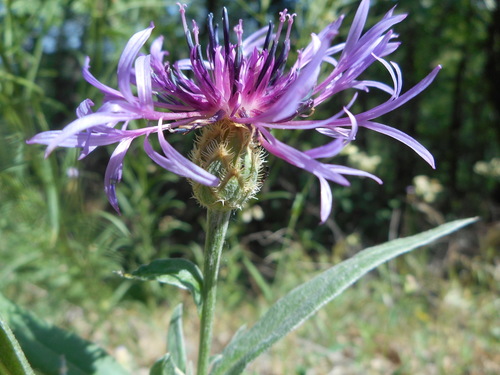
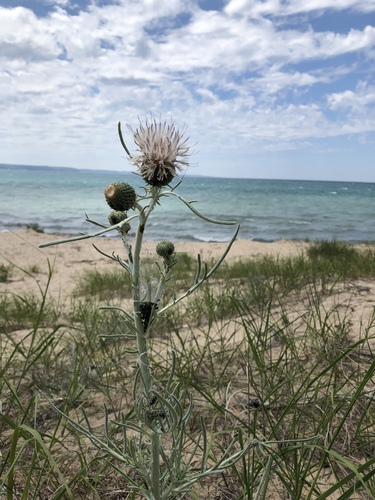
Pitcher's thistle (Cirsium pitcheri) has a modest appearance through most of its lifespan. It allocates most of its biomass to a massive taproot that can reach 2 meters (6 feet) in length. Its long, narrow gray-green leaves are protected by spines and covered in dense silvery hairs. Pitcher's thistle is monocarpic: it dies after flowering just once. Most individuals need at least 5 years to reach maturity, with abrupt maturation occurring between 2 and 8 years after germination. When mature, it produces a flower stalk 100 cm (40 inches) or taller. The top of the blooming stalk holds a large, showy flower head, with colors ranging from creamy white to very light pink, and guarded by spines. Some individual plants grow bushy and produce multiple flower heads. Flowering can occur any time between mid-June and mid-September, depending on the amount of energy stored in the plant's taproot and local rainfall conditions immediately before flowering. Most of this species' seeds do not disperse very far; entire flower heads are occasionally buried, which results in clusters of seedlings. Pitcher's thistle is adapted to grow on open, windswept, semi-stable sand dune surfaces. This species was first discovered by Dr. Zina Pitcher, an amateur naturalist and U.S. Army field surgeon stationed at Fort Brady, Sault Ste. Marie, Michigan. Sometime during an unknown summer in the 1820s, Pitcher was granted leave for a camping trip west of the fort, on a sandy shoreline of Lake Superior. He found the species in bloom while exploring what is now the Grand Sable Dunes of Pictured Rocks National Lakeshore. Pitcher sent the collected specimen to botanists, who later published a description and named the species Cirsium pitcheri in his honor. Pitcher's thistle is found exclusively along the shorelines of Lake Huron, Lake Michigan, and Lake Superior, and grows most often in sand dune habitat. Two of the largest remaining populations are located in the Nordhouse Dunes area of Manistee National Forest, and within Sleeping Bear Dunes National Lakeshore. The species also continues to grow and flower in smaller state park areas and private land tracts along these three lake shores.