About Cirsium muticum Michx.
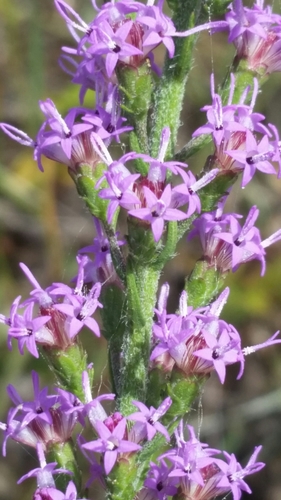
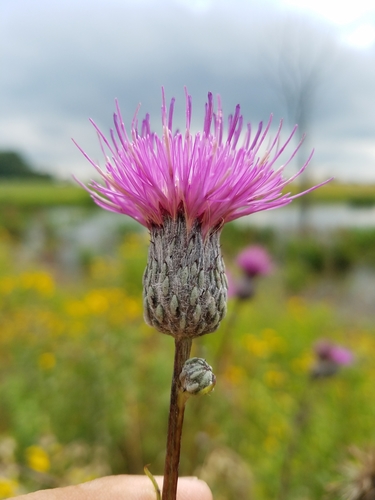
Cirsium muticum Michx. is a biennial plant that grows up to 180 centimetres (71 in) tall. It has a fleshy taproot, and a ridged stem that bears hairs near its base. Its leaves are arranged alternately, are ovate in shape, and pinnately lobed. The leaf lobes are often asymmetrical and irregularly forked, with fine multicellular hairs (trichomes) in the angles between lobes. Leaves get progressively smaller closer to the inflorescence, and the leaf underside usually has a small number of trichomes. The peduncles range from 0 to 15 cm (0.0 to 5.9 in) long; each holds an inflorescence made up of many tiny florets. The involucre is covered in cobwebby white hairs and is often slightly sticky. The purple florets can grow up to 27 mm (1.1 in) long. In terms of distribution and habitat, Cirsium muticum occurs in every Canadian province from Labrador and Newfoundland to Saskatchewan. In the United States, it grows mainly in the Northeast, the Great Lakes region, and the Appalachians, with isolated scattered populations across the South from Texas to the Carolinas. It is found most often in alkaline swamps, wetlands, marshes, and low forests, though some varieties are known to grow in wet alpine climates. Ecologically, Cirsium muticum acts as a host for several species of butterflies and moths. This includes the swamp metalmark butterfly (Calephelis muticum), a species currently undergoing risk assessment in the United States. The swamp metalmark lays its eggs on swamp thistle, and when the eggs hatch, the thistle's flowers are the only food source for the caterpillars. Cirsium muticum is also a larval host plant for the painted lady butterfly, and songbirds feed on its seeds. Plant species that commonly grow alongside Cirsium muticum include Aster umbellatus (flat-topped white aster), Solidago patula (rough-leaved goldenrod), Lysimachia quadrifolia (prairie loosestrife), and Gentiana procera (smaller fringed gentian).