About Cirsium funkiae Ackerf.
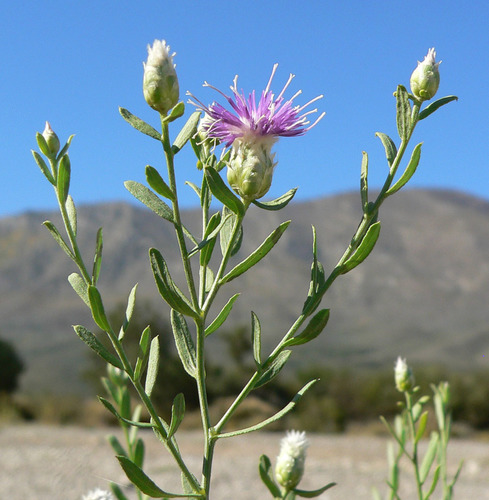
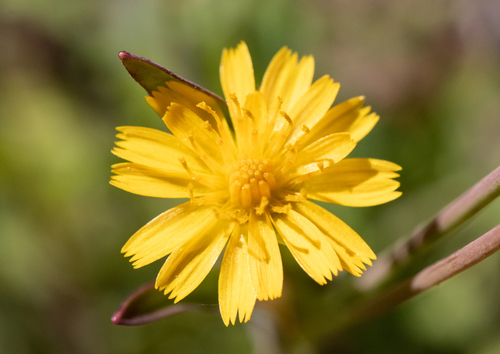
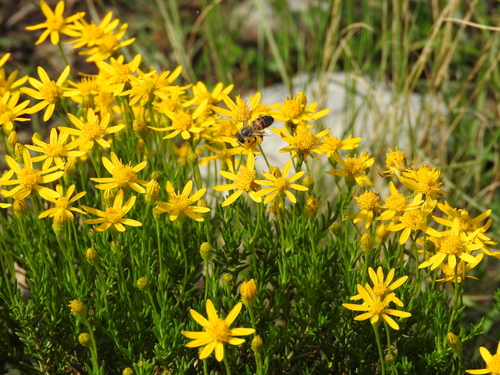
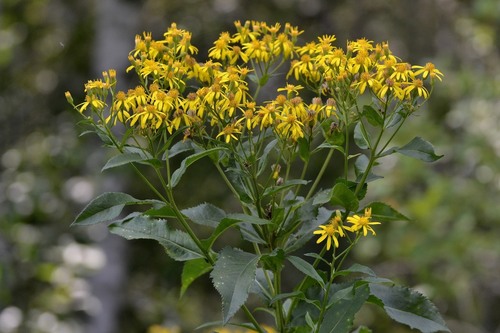
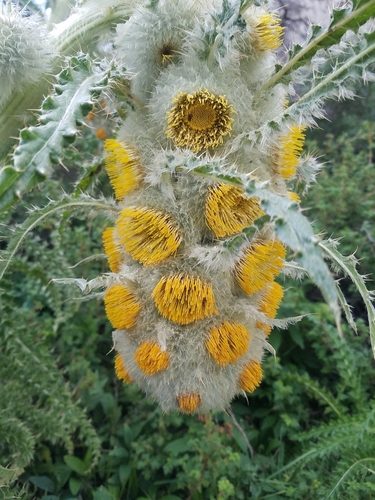
Cirsium funkiae Ackerf., commonly called the funky thistle, is a hairy perennial herb that reaches up to 0.91 meters (3 feet) in height. Its branches are yellow, and it produces pale yellow flowers that turn brown with age, growing in fuzzy clusters. The flower heads form nodding terminal clusters. The style branches are yellow, the corolla is pale yellow (turning brown when aged), and the anther tube is either white, or pale yellow with brown stripes. Its leaves are oblong or narrowly elliptic, undulate, and pinnately divided, measuring 8–25 centimeters (3.1–9.8 inches) long and 1.5–3.5 centimeters (0.59–1.38 inches) wide; leaf texture ranges from smooth to hairy. Seeds are dark brown or grayish brown, and 4–6 millimeters (0.16–0.24 inches) long. This species flowers from mid-July through late August, and fruits from mid-August to early September. When formally describing the species, Jennifer Ackerfield noted it was the "funkiest of all new thistles", and stated that the coloration of style branches, corolla, and flower head position (erect or nodding) are the best traits for identifying alpine thistles of the Southern Rocky Mountains. The funky thistle differs from the closely related Cirsium scopulorum by having yellow rather than white, pale pink, or purple style branches, but is similar in its shared arrangement of nodding terminal flower heads. Large funky thistle plants act as food sources for a variety of pollinators in their native habitat. Bumblebees (Bombus sp.) visit the plant, and often overnight in the fuzzy flower heads to stay warm. American pikas (Ochotona princeps) regularly forage on its leaves during August and September. The species' type specimen was collected at the base of Mount Sherman in Pike National Forest. It is found on mountaintops of the Sangre de Cristo Range, Mosquito Range, and Tenmile Range in central and southern Colorado. Its distribution extends north to Breckenridge, Colorado, and south to an isolated population near Santa Fe, New Mexico. The funky thistle grows at higher elevations above the tree line, occurring among spruce and fir forests and alpine tundra, but it grows most commonly in alpine meadows, boulder fields, or rocky scree slopes. At lower elevations, it associates with Bistorta bistortoides, Picea engelmannii, Potentilla pulcherrima, and Sibbaldia procumbens. On rocky slopes and in meadows, it grows alongside Cirsium griseum, Carex scopulorum, Castilleja miniata, Castilleja occidentalis, Claytonia megarhiza, Geum rossii, Senecio atratus, Senecio fremontii, Polemonium confertum, and Trifolium dasyphyllum. At its highest elevations on scree slopes, it is often the only plant species present, or associates only with Senecio soldanella. One recorded specimen grew in rocky tundra alongside Cerastium beeringianum, Heuchera parviflora, Pentaphylloides floribunda, and Trifolium dasyphyllum.