About Cirsium andersonii (A.Gray) Petr.
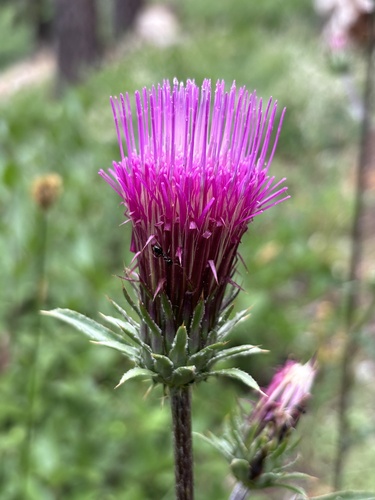
Cirsium andersonii is a North American thistle species commonly called Anderson's thistle and rose thistle. It is native to California, Oregon, and Nevada, where it grows in woodlands and forest openings in local high mountain ranges, including the Sierra Nevada and the southern Cascade Range. It has also been reported from Idaho. This native perennial herb grows erect, reaching a maximum height of nearly 100 cm (39 in). It produces one to multiple stems that are simple or branching, and may range from hairless to quite woolly. Its deeply lobed, sharply cut leaves grow from spiny-winged petioles; the longest leaves, found toward the base of the plant, reach over 30 centimetres (12 inches) long. The inflorescence holds one or more flower heads; the largest of these measure up to 5 centimeters long by 4 centimeters wide. Each head is lined with spiny, purple-tipped phyllaries that curve outward, and contains many red, purplish, or rose pink flowers that each reach up to 4.5 centimeters long. The fruit is an achene with a brown body 6 or 7 millimeters long, topped by a pappus that may be 4 centimeters long. Flower heads of this species attract hummingbirds. Asa Gray originally described this species as Cnicus andersonii, named after Charles Lewis Anderson; Petrak later moved it to the genus Cirsium, renaming it Cirsium andersonii.