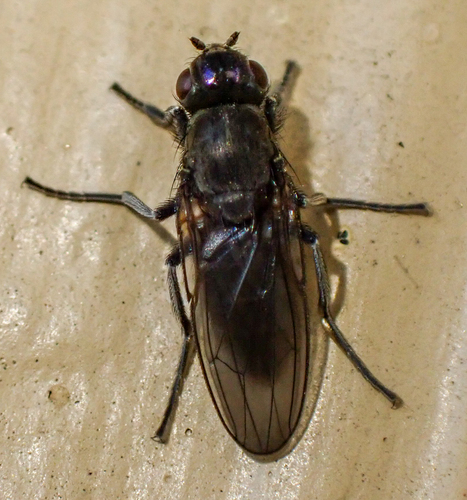
About Cirrula hians (Say, 1830)
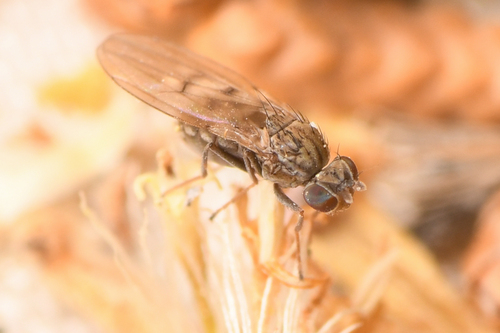
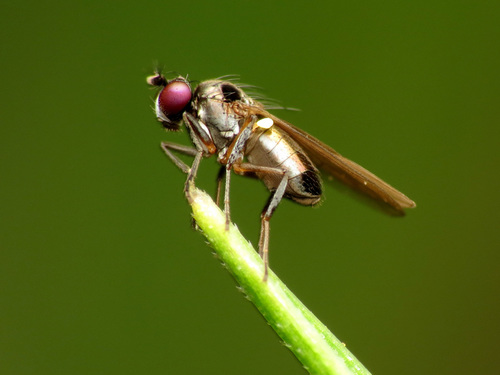
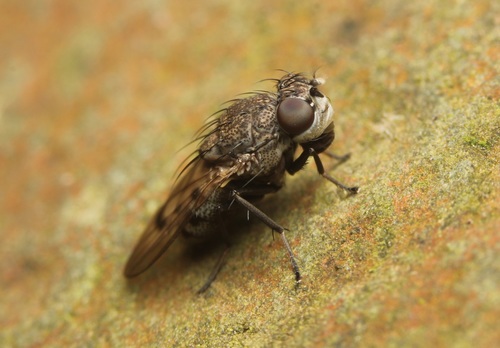
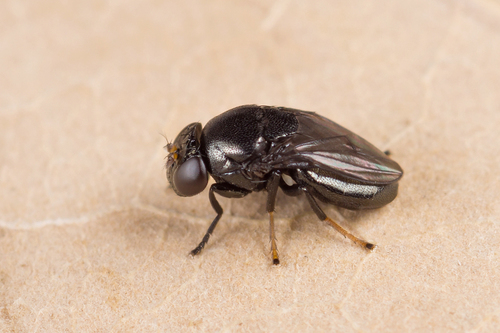
Adult Cirrula hians have dark brown bodies that measure roughly 4–7 millimeters (0.16–0.28 inches) in length. Their thorax has a metallic greenish or bluish sheen, and their wings are smoky brown. Larvae have a membranous cephalic region; the rest of the larval body is split into 3 thoracic segments and 8 abdominal segments.
This species occurs mostly in the northwestern United States, and is also found in Canada and Mexico. It prefers the benthic-littoral zone of habitats that contain large amounts of tufa, a type of porous limestone deposit. A large population of Cirrula hians lives at California's Mono Lake.
During summer, adult flies live for 3 to 5 days, feeding and laying eggs under the water surface. After hatching, larvae move through underwater environments, feeding on algae and bacteria. They stay submerged until they reach adulthood, getting oxygen from the photosynthesis of the algae they eat. Once mature, adult flies can walk on and under the water surface, and continue feeding on algae.
Short waxy hairs on the adult fly's body trap an air bubble around it, allowing it to submerge to depths of up to 24 feet (7.3 meters). The fly does not consume the air inside this bubble; instead, gas exchange between the bubble's surface and surrounding lake water allows the fly to breathe while submerged. This adaptation lets diving flies stay underwater for up to 15 minutes while searching for algae or secluded spots to lay eggs. The hypersaline water of this species' habitat is especially wet, so extra body hairs and special waxes are required to maintain the air bubble. To dive, a force equal to roughly 18 times the fly's body weight is needed to break through the water's surface tension.
Cirrula hians development and lifespan are sensitive to temperature changes. Colder temperatures extend their lifespan and slow the timing of each developmental stage. Adults do not lay eggs during winter, since eggs cannot complete adequate development in cold conditions, leading to a pause in reproduction. Flies do not go deeper than roughly 15 meters, due to the frigid temperatures found at these depths. The milder temperatures of spring and autumn are the most suitable for their growth.
You can hold these flies underwater for any length of time, and they are not bothered by the experience. When released, they pop back up to the surface completely dry, and walk away just as unconcerned as if they were specially adapted to provide this entertaining demonstration for people.
Historically, the Kucadikadi, a band of Northern Paiute people, used the pupae of this fly as a source of protein and fat. The name "Kucadikadi" translates to "eaters of the brine fly pupae". Around 200 Kucadikadi harvested pupae at Mono Lake year-round, with higher harvests in the summer. Dried pupae can be used to make stew. Considered a delicacy, the Kucadikadi also traded the pupae with other groups in the region.