About Cirrhitus rivulatus Valenciennes, 1846
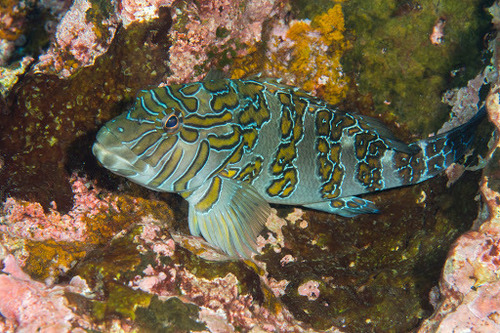
The giant hawkfish, scientifically named Cirrhitus rivulatus Valenciennes, 1846, has a deep body that is not highly laterally compressed. It has a large head with a blunt snout, and a fringe of cirri sits on the posterior margin of its anterior nostril. Its mouth is moderately large, holding two types of teeth: an outer row of canines and an inner row of villiform teeth. Teeth are also present on both the centre and the sides of the roof of its mouth. The upper margin of the preoperculum may either have small serrations or be smooth, and the gill cover bears 2 flattened spines. It has a continuous dorsal fin with 10 spines; the membranes between these spines have deep notches, and the tip of each spine has a large tuft of cirri. The dorsal fin also has 11 to 12 soft rays, and a small incision separates the spiny portion from the soft-rayed portion. The anal fin contains 3 spines and 5 to 7 soft rays. The caudal fin is truncate. The lower 7 pectoral fin rays are robust, with deeply incised membranes, and are notably longer than the other pectoral fin rays. The upper 1 pectoral fin ray and the lower 7 pectoral fin rays are unbranched. The pelvic fin has one spine and 5 soft rays, and its origin sits behind the base of the pectoral fin. This species' scales are smooth. The intraorbital space has no scales, and the cheeks have fewer than 12 irregular rows of small scales. There are 41 to 49 scales along the lateral line. This species reaches a maximum total length of 60 cm (24 in) and has a maximum published weight of 4.2 kg (9.3 lb); however, the International Game Fish Association recognizes the largest caught specimen as weighing 5.58 kg (12.3 lb), which was caught in 2019 off the coast of Ecuador. It is the largest species in the hawkfish family. Its overall body colour is greyish brown, with 5 vertical bars along the body. Each bar is made up of a complex of golden brown markings, each with a black margin that is in turn bordered by narrow bright blue edges. The head has thick golden-brown bands, which also have black margins bordered by slender blue edges, that radiate out from the eyes. Most individuals have a pair of white spots on the posterior part of their back. Juveniles have an overall white body marked with dark brown bars. The giant hawkfish is endemic to the eastern Pacific Ocean. It ranges from southern Baja California and the northern Sea of Cortez south to Ecuador, including all offshore islands within this range. It inhabits reefs in shallow waters, at depths down to 30 m (98 ft). Juveniles of this species are found in the surge zone and in tidal pools.