About Cirrhitus pinnulatus (Forster, 1801)
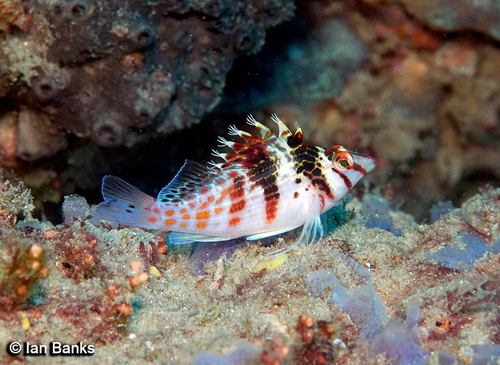
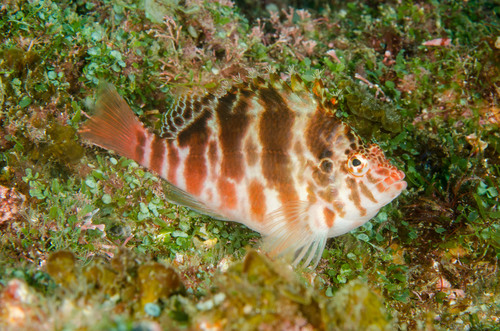
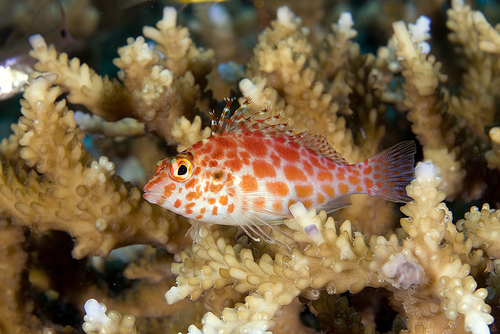
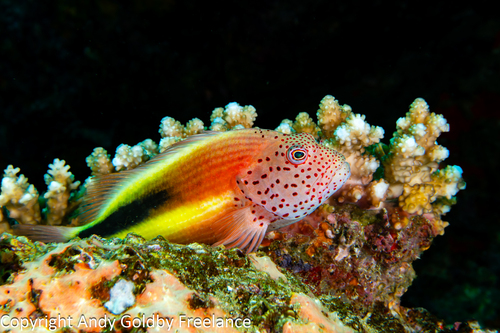
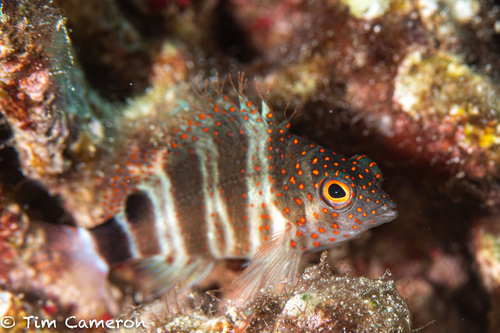
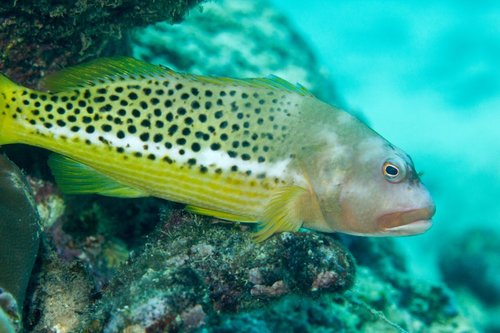
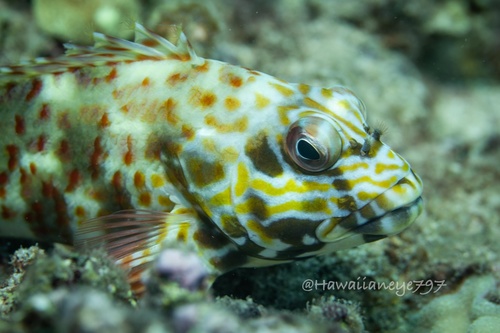
Cirrhitus pinnulatus has a body where standard length is roughly three times its body depth. Its head features a short, blunt snout and a large mouth that extends backward to the rear edge of the eye; a low bony ridge sits above the eye. The mouth holds two types of teeth: an outer row of canines and an inner row of villiform teeth. Teeth are also present on the center and sides of the mouth's roof. A fringe of cirri is present on the posterior margin of the anterior nostril. The upper margin of the preopercle has fine serrations. The continuous dorsal fin has 10 spines and 11 soft rays, with a deep incision between its spiny and soft-rayed sections, and a tassel of cirri near the tip of each spine. The anal fin has 3 spines and 6 soft rays. The caudal fin is gently rounded. Pectoral fins do not reach as far as the tips of the pelvic fins; there are 14 pectoral fin rays total, with the lower 7 being unbranched and robust. This species reaches a maximum total length of 30 cm (12 in), with 23 cm (9.1 in) being a more typical size. The overall body coloration of this hawkfish is brown, marked with white blotches and irregular reddish-brown spots across the body. The head bears sinuous reddish-orange lines and spots, and a dark saddle-like blotch sits on the dorsal section of the caudal peduncle. Cirrhitus pinnulatus has a wide distribution across the Indo-West Pacific. It is found from the Red Sea and the east African coast, south to Port Alfred in South Africa, and east across the Indian Ocean into the Pacific Ocean, reaching as far east as Hawaii, south to New Caledonia and Australia, and north to the Ryukyu Islands of southern Japan. In Australia, it occurs at Ningaloo Reef and Scott Reef in Western Australia, Cartier Reef in the Timor Sea, from Lizard Island to Escape Reef on the Great Barrier Reef in Queensland, and also at Christmas Island and the Cocos (Keeling) Islands. It can be found at depths between 1 and 23 m (3 ft 3 in to 75 ft 6 in), but it is most typically found at depths less than 15 m (49 ft). This species lives in exposed areas, including the surge zone on the seaward sides of reefs and along rocky coastlines.