About Cirrhitichthys oxycephalus (Bleeker, 1855)
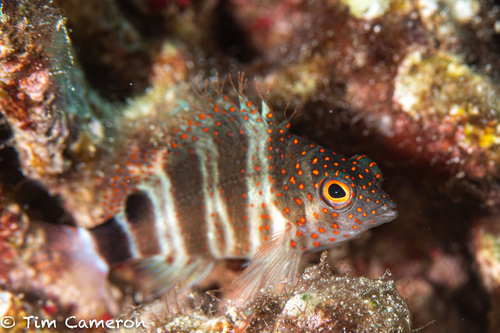
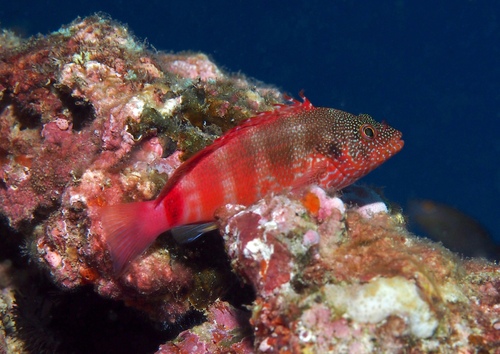
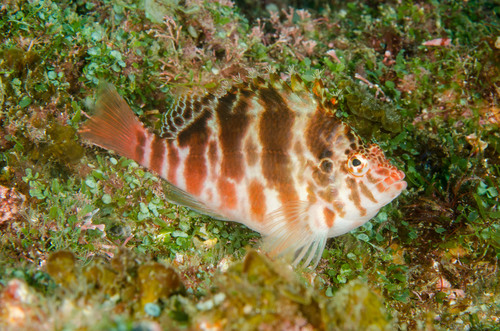
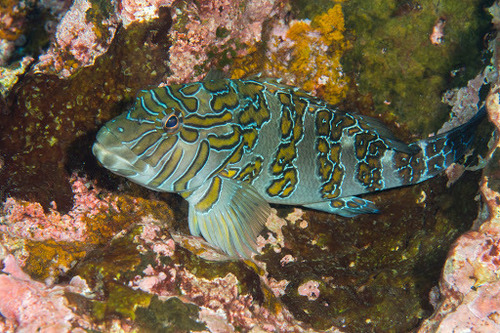
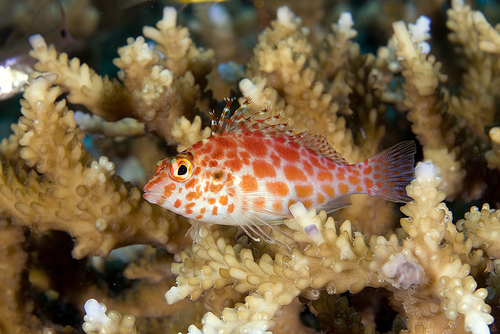
The coral hawkfish, Cirrhitichthys oxycephalus, has an oval, moderately compressed body with a pointed snout that has a straight profile. A fringe of cirri grows along the posterior edge of its anterior nostril. Its mouth is moderately sized, with a row of small canine-like teeth on the outer jaw and a band of simple teeth on the inner jaws. It also has teeth on the middle and sides of the roof of its mouth. The preoperculum has large serrations, and the gill cover bears 2 flattened spines. Its dorsal fin is made up of 10 spines and 12 to 13 soft rays, while its anal fin contains 3 spines and 6 soft rays. The dorsal fin is continuous, with a notch separating its spiny and soft-rayed sections. The membranes between the dorsal spines are deeply incised, and each spine has a tuft of cirri at its tip. The caudal fin is truncate. The lower 5 to 7 pectoral fin rays are robust, noticeably longer than the other pectoral fin rays, and separated by deep incisions in their connecting membrane. The uppermost 1 to 2 pectoral fin rays and the lowest 6 to 7 pectoral fin rays are unbranched. The pelvic fin has one spine and 5 soft rays, and its origin sits behind the base of the pectoral fin. The maximum recorded total length for this species is 10 centimetres (3.9 inches). This is a variably coloured species: its background colour ranges from whitish to pink, marked with blotches that vary in colour from reddish-brown to greyish or bright reddish-orange. The blotches are smallest along the lateral line. The spiny section of the dorsal fin has large spots, while the soft-rayed section of the dorsal fin and the caudal fin are both spotted. The pectoral fins are pinkish red, and the pelvic fins are transparent. This species has a wide distribution across the Indian and Pacific Oceans. It occurs from the Red Sea south along the East African coast as far as South Africa, and east across the Indian Ocean into the Pacific Ocean to the Marquesas Islands, reaching south to Australia and north to Japan. It is also found in the eastern tropical Pacific, from the Gulf of California south to Colombia and the Galapagos Islands. It inhabits areas of dense coral growth in the clear waters of lagoons, channels, or outer reefs, where it prefers locations below the surge zone. It occurs at depths down to at least 40 metres (130 feet).