About Cirrhitichthys aprinus (Cuvier, 1829)
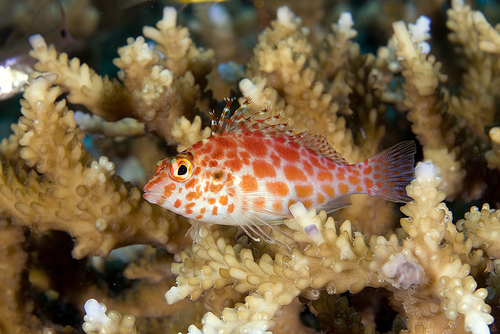
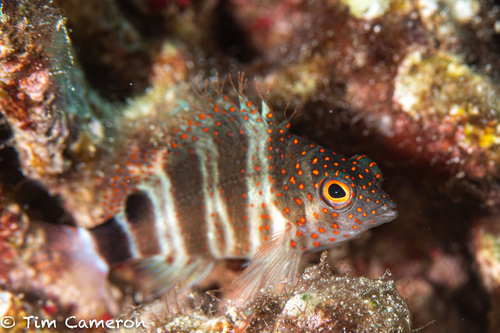
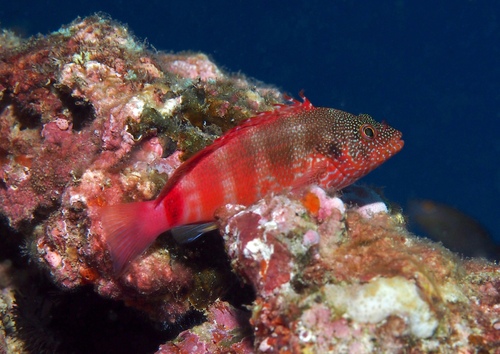
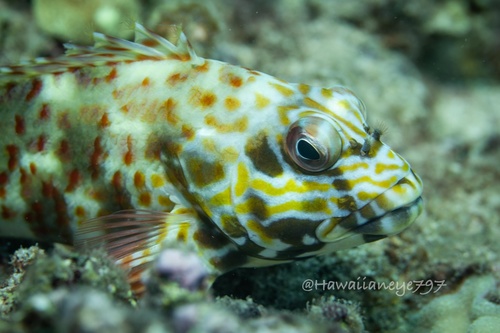
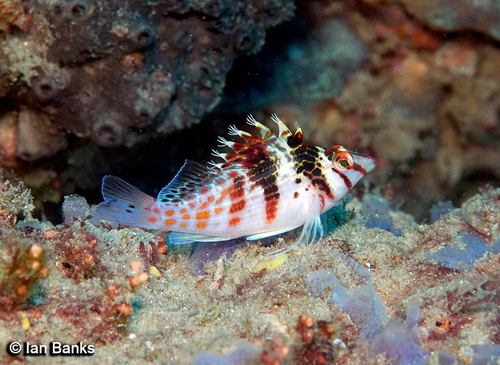
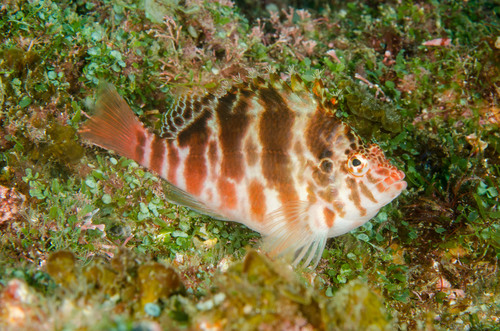
Cirrhitichthys aprinus, commonly called the spotted hawkfish, has a body where standard length is roughly two and a half times its body depth. This species has a strongly serrated preoperculum, and its entire body is covered in cycloid scales. Its dorsal fin holds 10 spines and 12 soft rays, while the anal fin has 3 spines and 6 soft rays. Each dorsal spine ends in a short white filament. The lower 7 pectoral fin rays are thick and unbranched. The pelvic fins extend past the anus, and the caudal fin is weakly emarginate. The spotted hawkfish reaches a maximum total length of 12.5 cm (4.9 in). Its base body color is whitish, marked with wide dark reddish-brown vertical bars along its flanks. These dark bars are interrupted by lighter bars that hold rhombus-shaped dark patches where the lighter bars cross the lateral line. There is a dark circular spot with a pale margin on the upper edge of the operculum, and 3 to 4 dark bars radiate outward from each eye. The caudal fin is translucent and has no markings. The spotted hawkfish’s range extends from Sumatra east to the Solomon Islands, north to the Philippines and the Ogasawara and Ryukyu Islands of southern Japan, and south to both the eastern and western coasts of Australia. In Western Australia, it occurs from the Houtman Abrolhos Islands to the Timor Sea east of Margaret Harries Bank, north of Melville Island in the Northern Territory. On Australia’s eastern coast, it is found from the northern Great Barrier Reef in Queensland south to Jervis Bay, and may range as far south as Merimbula, New South Wales. It also occurs at the Cocos (Keeling) Islands, Ashmore Reef in the Timor Sea, and Lord Howe Island in the Tasman Sea. Isolated records of this species exist from the western Indian Ocean, including reports from Aliwal Shoal off South Africa and the Maldives. This is a common species that lives in rocky and coral habitats on coastal reefs below the low tide mark, and it also enters shallow harbours and estuaries. It can be found at depths between 5 and 40 metres (16 and 131 feet).