About Circus ranivorus (Daudin, 1800)
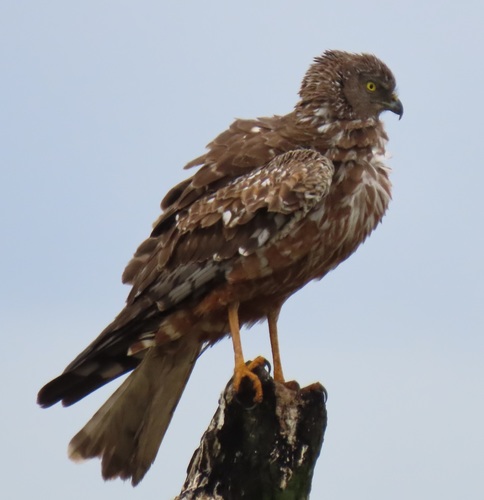
Description: The African marsh harrier (Circus ranivorus) shows sexual size dimorphism: females are larger than males, with a body length of 44–47 centimetres (17–19 in), and are approximately 30% heavier than males. Adults have yellow eyes, while immature individuals have brown eyes. Both sexes are mostly brown, with pale streakings on the head, breast, and forewing, and rufous coloration on the thighs and belly. Adult males can be distinguished from females by the pale grey wash on their dorsal secondaries and primaries; the equivalent feathers on females are brown. Juveniles are dark brown, and may have a pale breastband and pale markings on the head. At all ages, the tail and flight feathers have dark barring, but this barring is rarely visible in juvenile birds. This species resembles a small Eurasian marsh harrier, but it is slimmer and paler brown. It may be mistaken for an immature Montagu's harrier or pallid harrier, but can be readily distinguished by its lack of a white rump. The African marsh harrier is usually silent. During the breeding season, males produce a high-pitched, two-note display call, while only females give the far-carrying pseeew-pseeew call when soliciting food and during copulation. Habitat: The African marsh harrier generally occupies marshes or reedbeds in eastern Africa, and hunts over open grasslands and cultivated land near wetlands. It occurs from sea level up to 3,000 metres (9,800 ft), and predominantly lives at elevations above 1,500 metres (4,900 ft). Distribution: This harrier is mainly resident in the moister regions of southern and eastern Africa. Its range extends from the Western Cape northward through eastern South Africa, Lesotho, Eswatini, eastern Zimbabwe, south and western Mozambique, Malawi, southwestern Tanzania, western and central Zambia, and southeastern Angola, into northern Botswana (especially the Okavango Delta) and northeastern Namibia. Disjunct populations exist: one in northern Tanzania, two in the southern Democratic Republic of Congo, an additional population in eastern Democratic Republic of Congo, Rwanda and southeastern Uganda, and the northernmost population in northwestern Kenya, far northern Uganda and South Sudan. Habits and ecology: The African marsh harrier has a varied diet, of which 70% of food items are small mammals; it also eats adult birds, fledglings, lizards, frogs and large insects. It can sometimes consume birds as large as the Red-billed teal and the speckled pigeon. In some areas, doves (especially laughing doves) are a favoured prey. African marsh harriers do not occur in areas with annual rainfall below 300 millimetres (12 in), as wetlands are sparse in drier regions; the species' main prey in southern Africa, the striped mouse Rhabdomys pumilio, is also restricted to areas receiving at least this amount of annual rainfall. The harrier will also feed on carrion from larger animals such as flamingos, left by other predators like African fish eagles. Most prey is caught on the ground, but birds and insects are often caught in flight. Unlike many other harriers, the African marsh harrier is monogamous, and remains on its breeding territory for most of the year. In the southern Cape, birds leave the territory for a few months after breeding, returning between May and June. The nest is usually built in a reedbed, sometimes positioned well above the water. Two to four white eggs are laid from July to November. All newly laid eggs have a pale blue wash that allows them to be identified as fresh. Unlike other harriers, the African marsh harrier does not form communal roosts, and normally roosts solitarily. It leaves the roost early in the morning, then flies slowly low over the ground. It hunts in the typical harrier fashion, usually flying less than 10 metres above the ground over wetlands and adjacent drier ground.