About Circus cinereus Vieillot, 1816
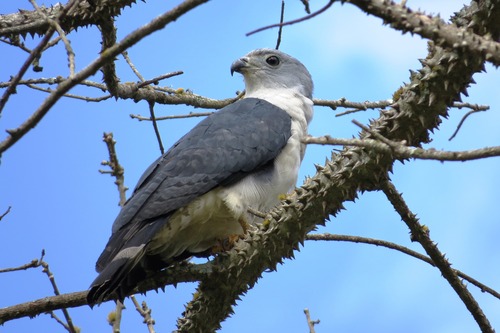
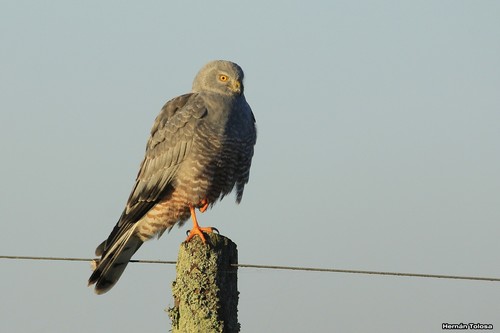
This species, scientifically Circus cinereus Vieillot, 1816, has distinct sexual dimorphism in plumage and size. Males have dark grey plumage on their upperparts, with black wingtips and a white rump. Their underparts are pale grey, and their bellies are marked with rufous streaks. Females have brown plumage on their upperparts, also with a white rump; their underparts are cream-colored, and their bellies are streaked in a pattern similar to males. Females are larger than males: the average total length of a female is 46 cm (18 in), while the average total length of a male is 40 cm (16 in). The species has an overall wingspan of 90–115 cm (35–45 in). The tail of this raptor measures 44.5 cm (17.5 in), and makes up about 56% of the bird's total length. This means Circus cinereus ties with the long-tailed hawk as the raptor with the longest tail relative to its body size.
Circus cinereus occurs in a variety of open habitats, from lowland marshes to the Andean Altiplano, and can be found at altitudes up to 4000 meters (13123 ft). Like other harriers, it nests on the ground. It is generally classified as a sedentary species, but some populations may migrate in April and May, returning to their breeding grounds between September and October.
During the breeding season, male and female Circus cinereus perform large aerial courtship displays and vocalize loudly with chattering calls. Eggs are laid in November, and young birds fledge by January. Nests are built within vegetation, and measure up to 40 centimetres (16 in) across and 30 centimetres (12 in) deep.