About Circus aeruginosus (Linnaeus, 1758)
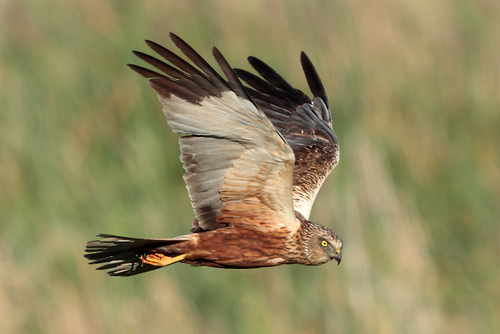
The western marsh harrier (Circus aeruginosus (Linnaeus, 1758)) measures 48 to 56 cm (19 to 22 in) in length, has a wingspan of 115 to 130 cm (45 to 51 in), and a weight range of 400 to 650 g (14 to 23 oz) for males and 550 to 800 g (19 to 28 oz) for females. This is a large, bulky harrier, larger than other European harriers, with fairly broad wings, and it shows distinct sexual dimorphism. The male's plumage is mostly cryptic reddish-brown marked with lighter yellowish streaks that are particularly prominent on the breast. The head and shoulders are mostly pale greyish-yellowish. The tail feathers, secondary remiges, and tertiary remiges are pure grey; the grey of these feathers contrasts with the brown forewing and the black primary remiges at the wingtips. The upper and underside of the wing look similar, though the brown color is lighter on the underwing. When seen from the side or below, flying males have a characteristic three-colored brown-grey-black pattern. The legs, feet, irides, and the cere of the black bill are yellow. The female is almost entirely chocolate-brown. The top of the head, throat, and shoulders are a conspicuously lighter yellowish colour; this lighter area can be clearly delimited and strongly contrasting, or more washed-out, especially in worn plumage, and resembles the head colour of the male. The eye area of the female is always darker, which makes the light-coloured eye stand out, while the male's entire head has very low colour contrast. The female also lacks the grey wing-patch and grey tail that males have. Juveniles are similar in appearance to females, but usually have less yellow colouring, particularly on the shoulders. A rare hypermelanic morph with largely dark plumage exists, and it is most often found in the eastern part of the species' range. Juveniles of this morph may look entirely black when in flight. This species has a wide breeding range that extends from Europe and northwestern Africa to Central Asia and the northern parts of the Middle East. It breeds in almost every European country, but is absent from mountainous regions and subarctic Scandinavia. It is rare but increasing in population in Great Britain, where it has spread as far as eastern Scotland. In the Middle East, populations occur in Turkey, Iraq, and Iran, while in Central Asia the range extends east as far as northwest China, Mongolia, and the Lake Baikal region of Siberia. Most populations of the western marsh harrier are migratory or dispersive. Some individuals winter in milder regions of southern and western Europe, while others migrate to the Sahel, Nile basin and Great Lakes region in Africa, or to Arabia, the Indian subcontinent, and Myanmar. The year-round resident subspecies harterti inhabits Morocco, Algeria, and Tunisia. Vagrants have been recorded in Iceland, the Azores, Malaysia, and Sumatra. The first documented, though unconfirmed, record for the Americas is of a bird reportedly photographed on 4 December 1994 at Chincoteague National Wildlife Refuge in Accomack County, Virginia. Confirmed records have been documented subsequently from Guadeloupe (winter of 2002/2003), from Laguna Cartagena National Wildlife Refuge in Puerto Rico (early 2004 and January/February 2006) and in Bermuda (December 2015). Like other marsh harriers, the western marsh harrier is strongly associated with wetland areas, especially those with abundant common reed (Phragmites australis). It can also be found in a variety of other open habitats, such as farmland and grassland, particularly where these areas border marshland. It is a territorial bird during the breeding season, and even in winter it appears to be less social than other harriers, which often gather in large flocks. This lower sociality is likely simply due to habitat preferences, as marsh harriers are completely allopatric, while several grassland and steppe-dwelling relatives of C. aeruginosus winter in the same regions and gather at food sources such as locust outbreaks. Even so, around 100 Eurasian marsh harriers are observed roosting together each November and December in Keoladeo National Park of Rajasthan, India. They gather in tall grassland dominated by Desmostachya bipinnata and vetiver (Chrysopogonogon zizanioides), but when this habitat is too disturbed by human activity they will use floating carpets of common water hyacinth (Eichhornia crassipes) instead. The choice of these roost sites may help provide early warning of predators, which will rustle noticeably through the plants if they attempt to sneak up on resting birds. The western marsh harrier hunts in the typical harrier style: it glides low over flat open ground while searching for prey, holds its wings in a shallow V-shape, and often keeps its legs dangling. It feeds on small mammals, small birds, insects, reptiles, and frogs.