About Circaetus pectoralis A.Smith, 1829
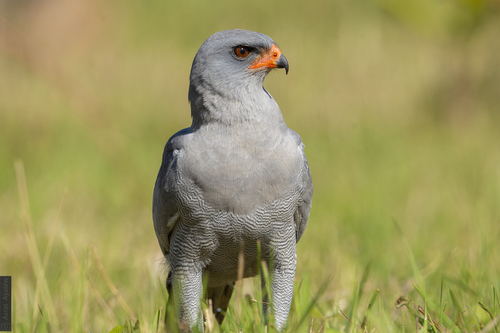
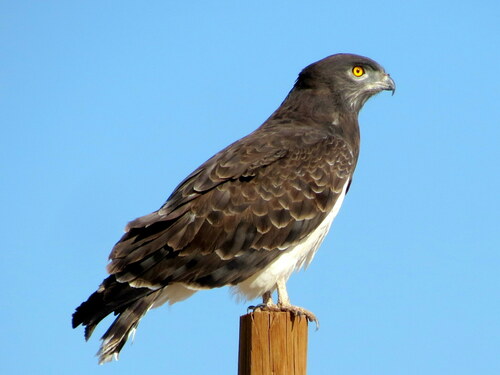
Identification: The main identifying feature of this bird is its dark brown-black head and chest, which gives the species its common name. It can be told apart from the short-toed snake eagle and Beaudouin's snake eagle by its uniformly white lower underparts. By contrast, the short-toed snake eagle has a darkly blotched belly, and Beaudouin's snake eagle has narrowly barred lower underparts. When in flight, its dark head and chest stand out against its white lower underparts and white underwings; the only exception to the white underwings are three narrow black terminal bars. Males and females have identical plumage, though females are noticeably larger than males. In the wild, this species can also be mistaken for the martial eagle (Polemaetus bellicosus). However, it differs from the martial eagle through its smaller size, unmarked rather than spotted breast, and white rather than brown-black underwings. Its eye is bright yellow-orange, its bill is horn-coloured, and its legs are pale grey and unfeathered below the thigh, matching the leg structure of other snake eagles. Its call is a whistled sequence of kwo kwo kwo kweeoo.
Distribution: This species has an Afrotropical distribution, and occurs across southern and East Africa. Its range extends from Ethiopia and Sudan in the north to South Africa, north of 26°S, in the south, and reaches as far west as the southern Democratic Republic of the Congo and southeastern Gabon. It is a partial migrant. Many populations in southern Africa and East Africa are year-round residents, while the species has only ever been recorded as a breeding visitor in Sudan. In Ethiopia and the former Transvaal, it is mostly a non-breeding visitor, and is considered locally nomadic there. Even in areas where the species is classed as resident, seasonal movements have been recorded; for example, an influx of birds occurs during the dry winter months in Zimbabwe.
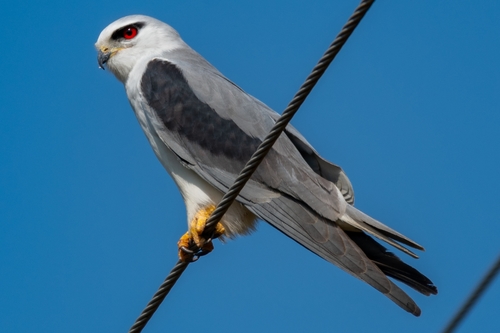
Habitat: This species lives in a wide range of different habitats, including open acacia and miombo woodlands, grasslands, thornbush savannas, and even semi-arid savanna and desert areas. It avoids mountainous and forested areas. It is usually found alone, though communal roosts holding up to 200 birds have been recorded during the non-breeding period. The species is also known to use human-created habitats such as farmland, and will perch on electricity pylons or telephone poles. Across most of its range, it occurs alongside the brown snake eagle, and the two species have been reported to nest on neighbouring or even the same pylon with no visible aggression toward one another.
Feeding Ecology: As its common name suggests, this bird feeds mostly on snakes, particularly venomous snakes up to 80 cm in length, but it will also hunt lizards, insects, small mammals and frogs. It mostly hunts from a perch, or hunts by hovering or searching the ground; it stalks prey while in flight, then parachutes slowly down to the ground to capture its prey. The species is highly dependent on seasonal changes in small mammal prey availability: in Serengeti National Park, its population numbers increase alongside booms in small mammal abundance. A specimen collected from Morogoro in 1922 was found to have a pellet of rodent fur and a hissing sand snake in its stomach contents.
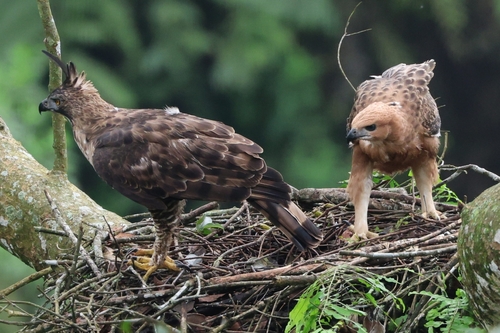
Reproduction: The black-chested snake eagle builds its nest in trees, typically in the crown of a flat-topped acacia, though there is one recorded instance of the species nesting in the pine Pinus patula. It usually builds its nest hidden within mistletoe or other epiphytic vegetation. The nest itself is a small structure made of sticks. The female lays only one white, unmarked egg per clutch. The egg is incubated for 52 days; the female handles incubation alone, while the male brings her food. After hatching, the chick stays in the nest for approximately 3 months (90 days). Breeding can take place year-round, but peaks during the dry winter months in South Africa. In Kgalagadi Transfrontier Park, the peak egg-laying period falls between June and July, while egg laying happens slightly later in the former Transvaal, around July to August. In Zimbabwe and Zambia, nests with eggs have been found from February to December. In Zambia, egg laying peaks around April to July, while in Zimbabwe it peaks around July to September.