About Cipangopaludina chinensis (J.E.Gray, 1833)
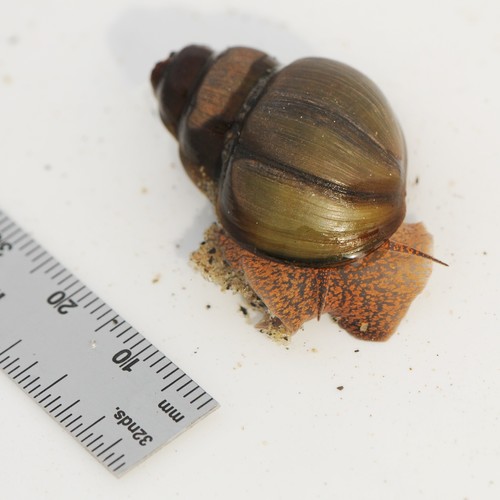
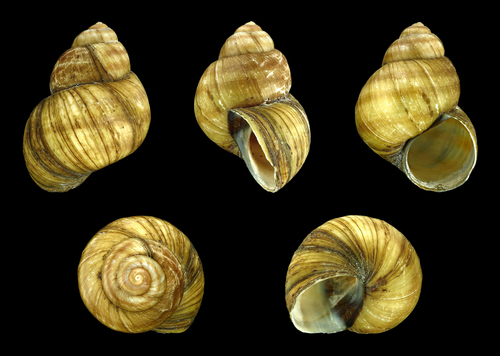
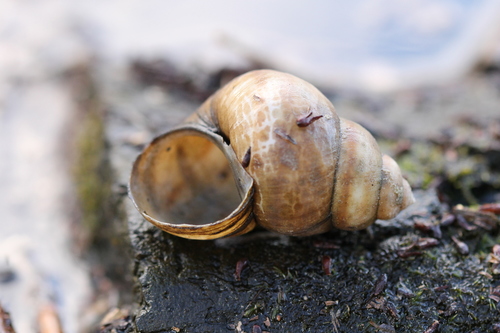
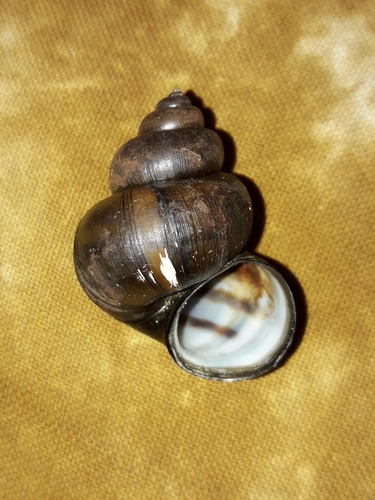
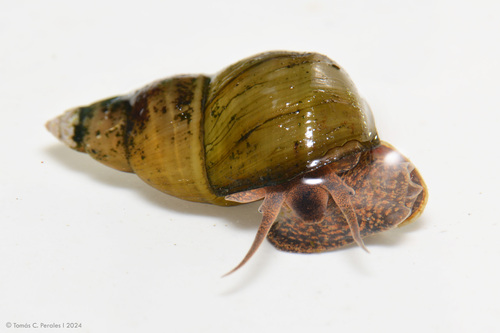
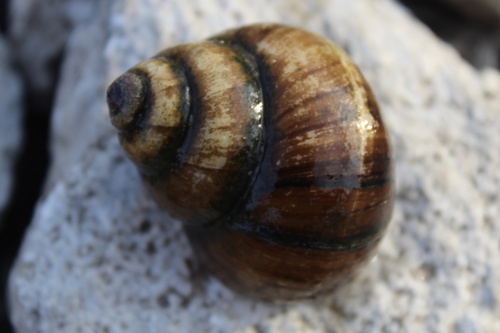
Cipangopaludina chinensis (Gray, 1833) is also sometimes called Bellamya chinensis, and is commonly known as the Chinese mystery snail. Members of the genus Cipangopaludina can be identified by their relatively large globose shells and concentrically marked opercula. The shell of this species is conical, thin but solid, with a sharp apex, a relatively high spire, and a spaced-apart body whorl. This species has a small, round umbilicus, and the spire forms an angle of 65 to 80 degrees. Juvenile Cipangopaludina chinensis have light coloration, while adults have pigmentation that ranges from olive green, greenish brown, and brown to reddish brown. The inner surface of the shell is colored from white to pale blue. The shell surface is smooth, with clear growth lines, and the shell holds 6.0 to 7.0 whorls total. This is a large gastropod species; most individuals have a shell height of 40 millimeters (1.6 in) and a shell width of 30 millimeters (1.2 in). The largest recorded specimens reach 60 millimeters (2.4 in) in height and 40 millimeters (1.6 in) in width, and shell height can reach as much as 65 millimeters (2.6 in). The width-to-height ratio of the shell of this species falls between 0.74 and 0.82. The aperture is ovoid, with simple outer and inner lips. In juveniles, the final whorl has a distinct carina, and the shell has grooves with 20 striae per millimeter between each groove. Juveniles also have a detailed pattern on their periostracum: this pattern includes two apical rows and three body whorl rows of hairs that have long hooks on their ends, distinct ridges, and many additional hairs with short hooks. The shell of Cipangopaludina chinensis grows allometrically, with height increasing faster than width. Compared to the closely related Cipangopaludina japonica, this species' shell growth rate is slower, and adult shells are less elongate than those of Cipangopaludina japonica. The radula may also differ between Cipangopaludina chinensis and Cipangopaludina japonica, but there is so much variation within a single species that radula structure is not a useful diagnostic characteristic for telling the two species apart. As a general observation from one North American population, the radula of Cipangopaludina chinensis has seven small cusps on the marginal tooth, and a large central cusp with four small cusps on each side. Like other mystery snails and unlike apple snails, this species does not have a siphon, it gives birth to live young, and it only has one set of tentacles, like all other aquatic snails. This species is native to East Asia, with a native range extending from Southeast Asia to Japan and eastern Russia, covering an area from the tropics of Indochina to northern China. It is widely distributed across China, including on the Chinese Loess Plateau. It has also established non-native populations in North America. Cipangopaludina chinensis prefers freshwater habitats including lakes with soft, muddy or silty bottoms, reservoirs, slow-moving freshwater rivers, streams, paddy fields, and ponds that contain aquatic grass. Individuals creep along the bottom of the water or on aquatic grasses. In eastern North America, it prefers lentic water bodies with substrates of silt, sand, and mud, though it can also survive in slower moving sections of streams. It can even tolerate conditions in stagnant waters located near septic tanks. In eastern North America, this species has been found in waters with a pH between 6.5 and 8.4, calcium concentration of 5 to 97 ppm, magnesium concentration of 13 to 31 ppm, oxygen concentration of 7 to 11 ppm, depths from 0.2 to 7 meters, conductivity of 63 to 400 μmhos/cm, and sodium concentration of 2 to 49 ppm. The optimal water temperature for its growth and development falls between 20 and 28 °C. It hibernates when water temperature drops below 10 to 15 °C, or rises above 30 °C. Reproduction in this species is sexual, and it is ovoviviparous. Females can live up to 5 years, while males live up to 3 years, and occasionally reach 4 years of age. Over their lifetime, females usually produce more than 169 live young, and a single brood can contain as many as 102 developing young. In eastern North America, all females generally carry embryos from May to August, and young are born between June and October in shallow water. In the fall, after birthing is complete, females migrate to deeper water to spend the winter. Females produce more young during their 4th and 5th years than they do in earlier years. This species is one of the three predominant freshwater snails sold in Chinese markets. It is widely eaten by people across most of China, as its meat is considered delicious, is nutritionally rich, has a high protein content, and has a low fat content. In China, it is also used in traditional medicine to treat digestive diseases. Abundant shells of this species have been found at Mid-Late Neolithic archaeological sites in the Guanzhong Basin of Northwestern China; these are remains of prehistoric meals, where the snail flesh was consumed primarily as a subsidiary food. This snail is also one of the rice field snail species that has been traditionally eaten in Thailand.