About Ciona robusta Hoshino & Tokioka, 1967
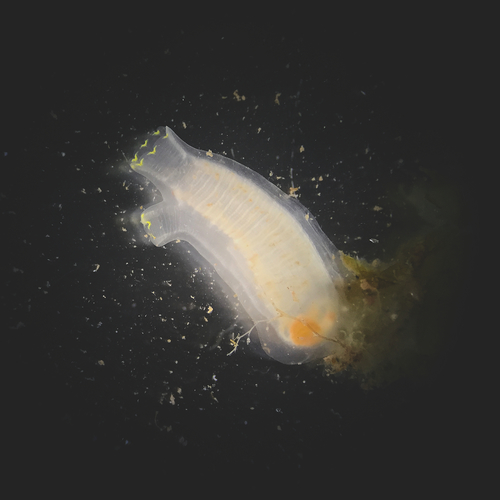
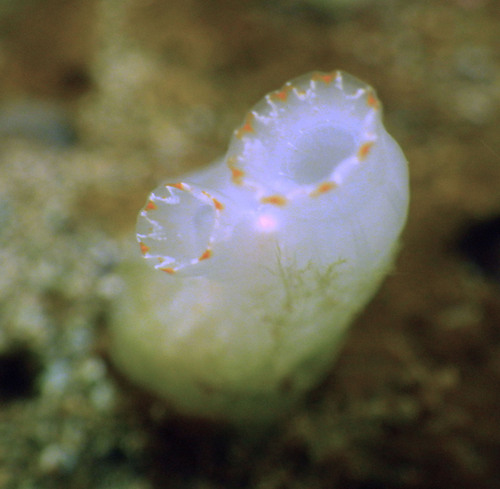
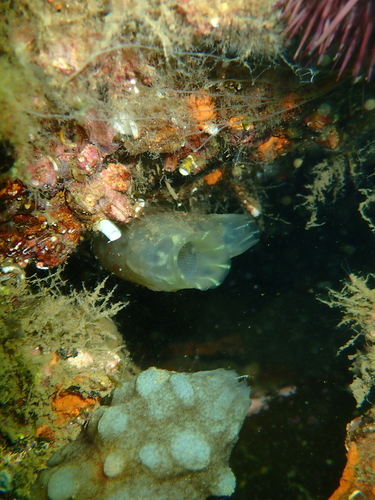
Ciona robusta has a translucent tunic, and a white or off-white body, with orange to red dots on the scalloped edges of its siphons. Most of its tunic is soft, flexible, and gelatinous; the only exception is the posterior end, which is tough and typically mostly white or yellowish white. Muscle bands, organs, and tubercles can usually be seen beneath the tunic. Tubercles are most visible near the siphons and scattered across the tunic surface. These tubercles are very small, so histological sectioning or 3-D imaging may be needed to view all of them.
The body of Ciona robusta is elongated, cylindrical, and vase-shaped, with five to seven longitudinal bands on each side that extend almost the entire length of the body. Its body tears easily, though related species such as Ciona savignyi are even more fragile. The siphons of Ciona robusta are short and directed forward. The oral siphon, which contains eight lobes, is larger than the six-lobed atrial siphon. Both siphons have a pale white or yellowish tinge when any color is present at all.
In terms of size, Ciona robusta can reach 210 mm (8.3 in), but most individuals do not grow larger than 100–120 mm (3.9–4.7 in). Ciona robusta is a marine filter (suspension) feeder. To feed, it draws water in through the oral siphon, which holds gills that filter the species' main food sources: phytoplankton, bacteria, and detritus. Mucus strings move filtered food into the stomach and intestines, and water is finally expelled through the atrial siphon.
This species is primarily found in subtidal areas, though it sometimes occurs in the low intertidal zone. It prefers a salinity range of 11 to 50 ppt, is highly tolerant of varied salinity conditions, and can reproduce at salinities up to 40 ppt. It survives in water temperatures ranging from 10 to 30 degrees Celsius, and can tolerate temperatures as low as -1 C for months at a time.