About Cinnyris sovimanga (Gmelin, 1788)
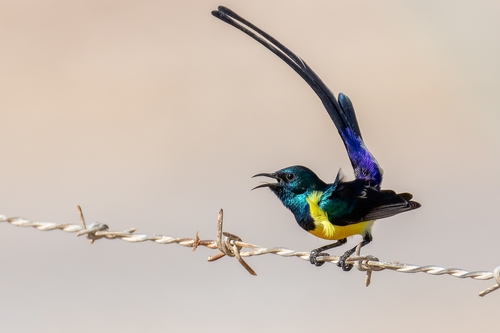
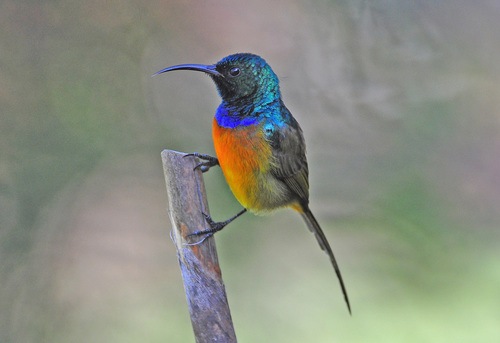
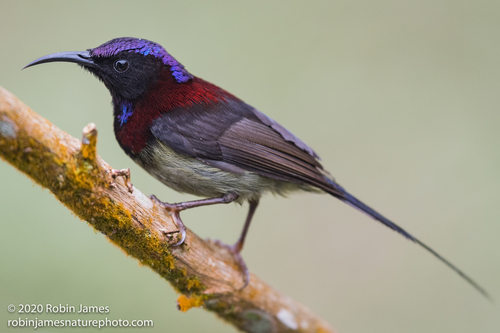
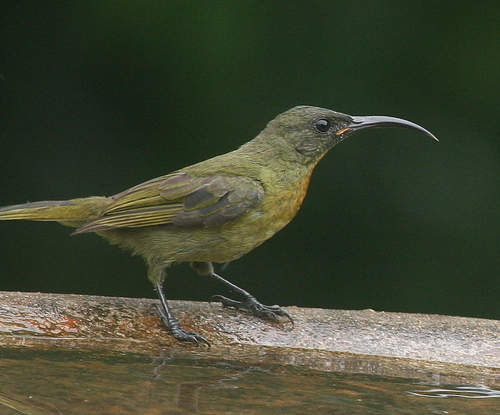
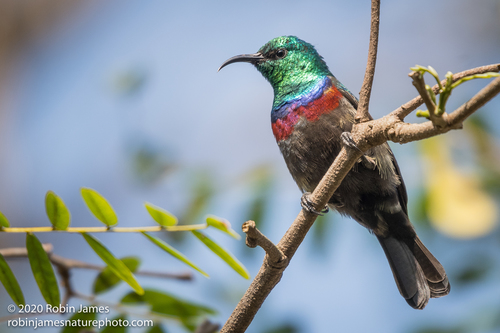
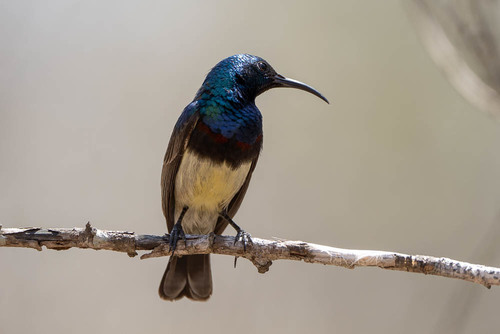
This species, the souimanga sunbird, has the scientific name Cinnyris sovimanga (Gmelin, 1788). Souimanga sunbirds measure 10 centimetres (3.9 in) in length with a 13 centimetres (5.1 in) wingspan. They have a long, thin, curved black bill. Males of the nominate subspecies have metallic green feathering on the head, back, and throat. Their breast is blackish with a more or less continuous red band, their belly is yellow, and their wings and tail are brown. Yellow tufts grow on the sides of their breast; these become visible when the birds lift their wings during courtship display. Males are presumed to moult into a duller eclipse plumage by March to April, losing most of their metallic and red feathering for a few months. Females have grey-brown upperparts, a dull yellow belly, and a grey throat and breast with darker markings. Juveniles resemble adult females, but their chin and throat are sometimes black, and their upperparts may be more olive in tone. The subspecies C. s. abbotti is larger, measuring 11 centimetres (4.3 in) long with a 14 centimetres (5.5 in) wingspan. Males of this subspecies have a broader red breastband, and there is no yellow on the dark brown underparts of C. s. abbotti or the blackish underparts of C. s. buchenorum. For males in the nominate group, wing length is around 50–58 millimetres (2.0–2.3 in), tail length is around 31–41 millimetres (1.2–1.6 in), and bill length is 20–25 millimetres (0.79–0.98 in). Females are 10% smaller in these measurements than males. This bird makes a chirruping flight call, and a loud, hoarse alarm call. Only males sing; their song is fast and scratchy, with frequently repeated phrases. Along with the Malagasy white-eye and the Madagascar cisticola, souimanga sunbirds are the most common small landbirds across most of their range. Healthy populations of this species and the Malagasy white-eye persist in the roughly 4 square kilometres (1.5 sq mi) of habitat on the Glorioso Islands. The IUCN has classified this species as least concern. Souimanga sunbirds live in a wide variety of habitats, ranging from mountain forests to mangroves and scrubland, as well as in parks, gardens, and other human-modified ecosystems. They use their curved bill to probe flowers for nectar, and also feed on insects and spiders. They have very few natural enemies, and their nests are inaccessible to most predators.