About Cinnyris pulchellus melanogastrus (Fischer & Reichenow, 1884)
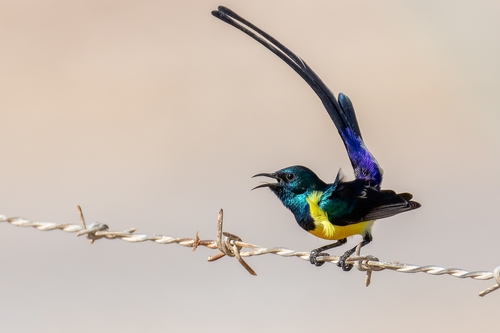
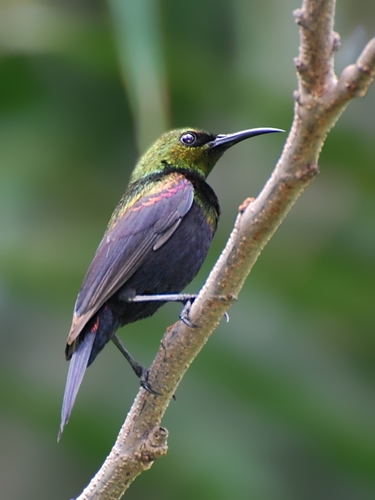
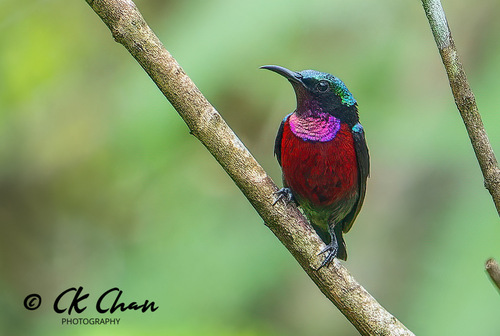
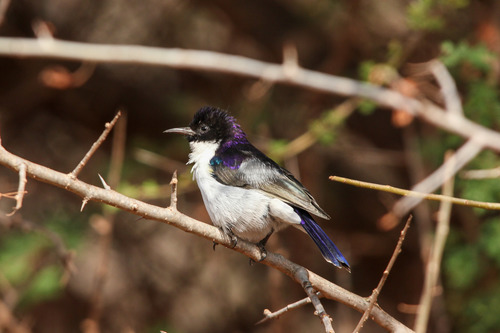
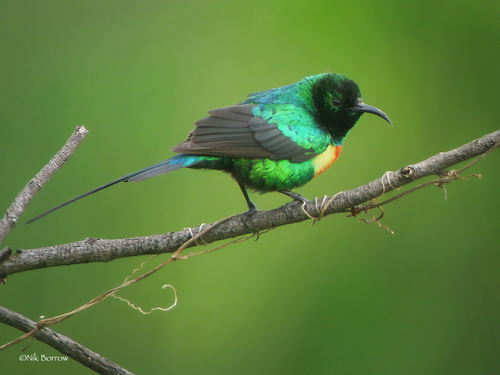
This subspecies of beautiful sunbird is tiny, measuring 10 cm (4 in) in length, and the breeding male’s long tail adds an extra 5 cm (2 in). It has medium-length, thin, down-curved bills and brush-tipped tubular tongues, both traits that are adaptations for feeding on nectar. Males have a black head, bright metallic green upperparts, a scarlet breast bordered with yellow, a black belly, and greatly elongated central tail feathers. Females are brown on the upperparts with yellowish underparts. This beautiful sunbird occurs across Benin, Burkina Faso, Cameroon, the Central African Republic, Chad, the Democratic Republic of the Congo, Côte d'Ivoire, Eritrea, Ethiopia, Gambia, Ghana, Guinea, Guinea-Bissau, Kenya, Mali, Mauritania, Niger, Nigeria, Senegal, Sierra Leone, South Sudan, Sudan, Tanzania, Togo and Uganda. It inhabits a variety of open habitats that have some trees, including savannah, riverside thickets, mangroves, beachsides and gardens. Sunbirds are a group of very small Old World passerine birds that feed largely on nectar, though they also eat insects, especially when feeding their young. Their flight is fast and direct on short wings. Most sunbird species can take nectar by hovering like a hummingbird, but usually perch to feed most of the time. The beautiful sunbird is a common breeder across sub-Saharan tropical Africa. It lays one or two eggs in a suspended nest built in a tree, and is a seasonal migrant that moves within its range.