About Cinnyris osea Bonaparte, 1856
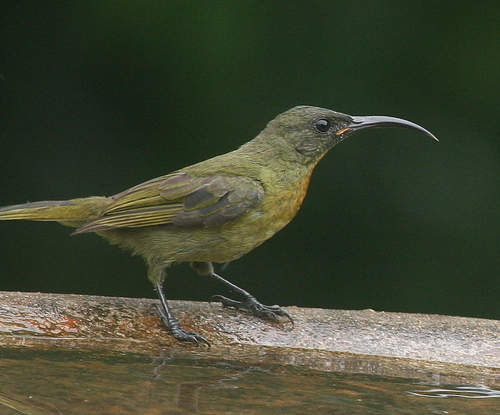
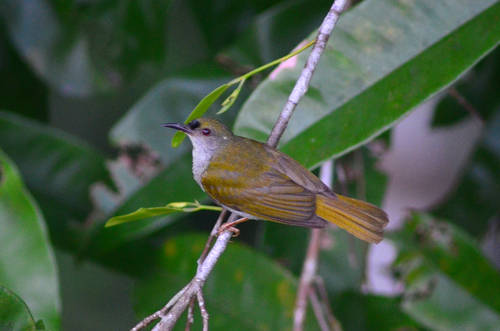
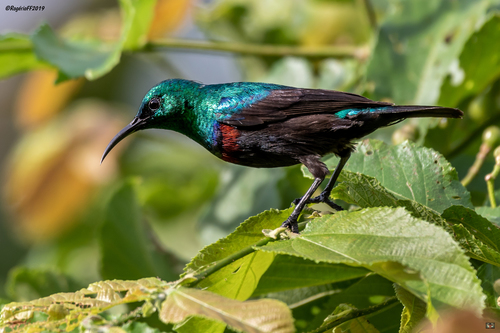
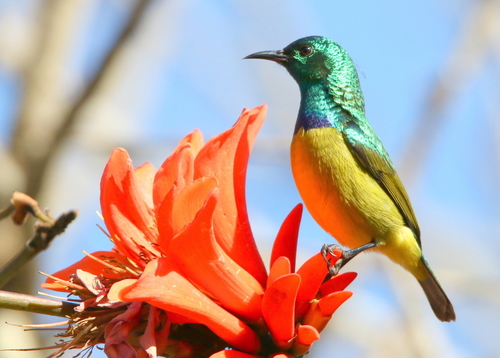
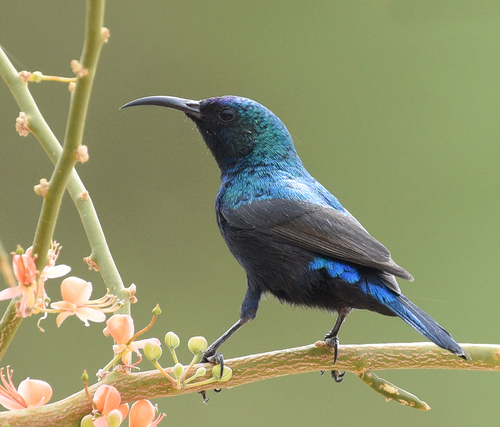
Cinnyris osea, commonly called the Palestine sunbird, measures 8 to 12 cm in length with a 14 to 16 cm wingspan. Average weights differ by sex: males weigh 7.6 g, while females weigh around 6.8 g. It has a fairly long, curved, downward-sloping black bill. Breeding males have mostly dark plumage that looks glossy blue or green when viewed in light, and they have hard-to-see orange tufts on the sides of the breast that are only visible at close range. Females and juvenile Palestine sunbirds are grey-brown on their upperparts and pale on their underparts. Non-breeding males resemble females and juveniles, but may retain some dark feathers. This species produces a high, fast, jingling song, along with a variety of calls including a harsh alarm call. The Palestine sunbird lives in warm, dry climates, at elevations ranging from sea level up to 3200 m. It inhabits dry woodland, scrub, wadis, savannas, orchards, and gardens, and is common in towns in some parts of its range. Two subspecies are recognized. The nominate subspecies C. o. osea, native to the Middle East, breeds from Israel, Palestine, and Jordan in the north southward through western Saudi Arabia to Yemen and Oman. Over the last century, the expansion of Israeli settlements and the growing popularity of cultivated tropical plants in urban gardening have played a significant role in the spread of this subspecies across the region. In recent decades, C. o. osea has colonized Egypt's Sinai Peninsula. It has been recorded breeding in Lebanon, and regularly overwinters in both Lebanon and Syria. The African subspecies C. o. decorsei has a very localized range across parts of Sudan, northwestern Uganda, the Central African Republic, northeastern Democratic Republic of the Congo, and northern Cameroon. The Palestine sunbird builds a purse-shaped nest that hangs from a branch of a tree or bush. The nest measures 18 cm long and 8 cm wide at its base. It is constructed from leaves, grass, and other plant material bound together with hair and spider webs, and lined with wool and feathers. Females lay between one and three smooth, glossy eggs. The eggs vary somewhat in color, but are most often white or grey with faint markings at the broader end. Eggs are incubated for 13 to 14 days. Hatchlings are downy with an orange-red mouth, and fledge 14 to 21 days after hatching.