About Cinnyris lotenius (Linnaeus, 1766)
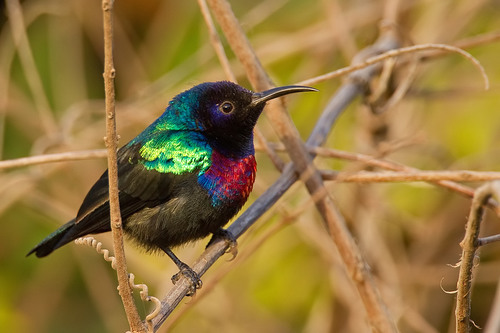
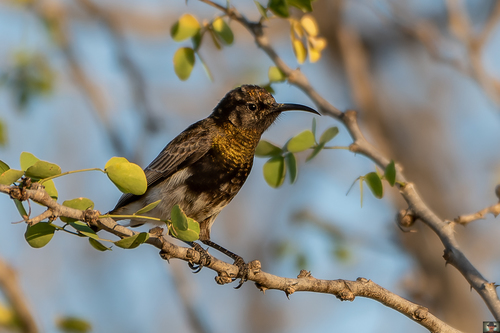
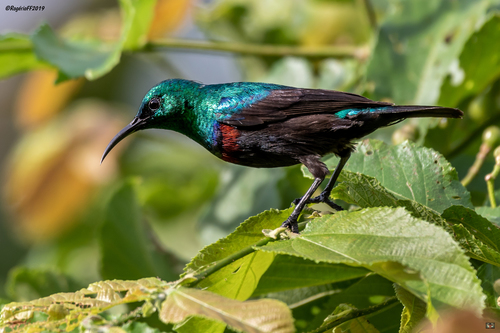
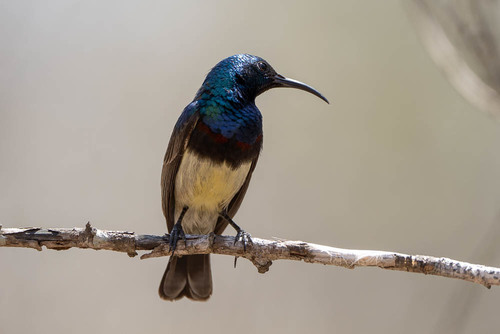
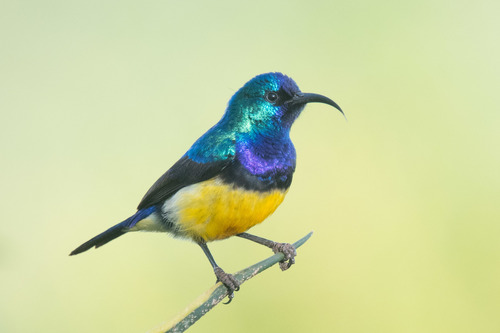
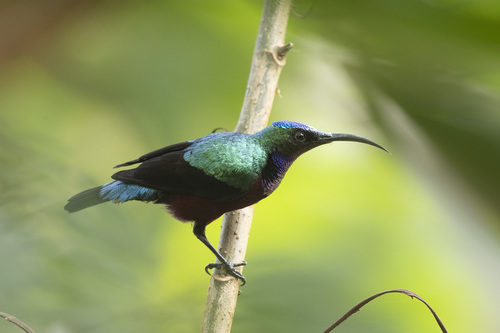
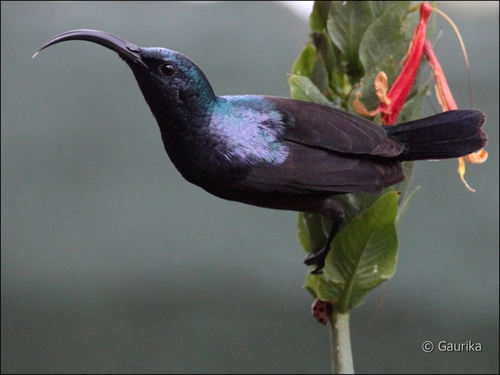
Loten's sunbird (Cinnyris lotenius) is a small sunbird species measuring 12–13 cm in length. Its long bill distinguishes it from the syntopic purple sunbird. This species has browner wings than the purple sunbird. Under good lighting conditions, males show a visible maroon breast band. Adult males are mainly glossy purple with a grey-brown belly, and have pectoral tufts of yellow mixed with crimson that they use during displays. Females have yellow-grey upperparts and yellowish underparts, and lack the faint supercilium present on purple sunbirds. Loten's sunbirds have long down-curved bills and brush-tipped tubular tongues, which are adaptations for nectar feeding. Bill length varies across populations, with the longest bills found in eastern Peninsular India and Sri Lanka. The species has a distinctive buzzy zwick zwick call, and individuals are very active, often bobbing their heads while foraging. The male's song is a long repeated wue-wue-wue... with the last notes accelerated; this song has been compared to the call of the cinereous tit. Males may sing from the tops of bare trees or telegraph wires. It has been reported that males have an eclipse winter plumage with a yellowish underside that resembles the female's underside, but with a broad central streak of dark metallic violet running from the chin to the belly. Rasmussen & Anderton (2005) questioned the existence of this eclipse plumage in adult males due to a lack of supporting specimens. Jerdon, however, noted that a specimen held at the Museum As. Soc., Calcutta, had what was described as winter or currucaria plumage: a central glossy green stripe on the throat and breast, and a spot on the wing shoulders, with other features matching a female. Jerdon added that he did not recall seeing the bird with this plumage in Malabar, despite having many opportunities to observe it there, and suggested the specimen was likely a young bird instead. Loten's sunbird is found only in peninsular India and Sri Lanka. Its core range extends along the Western Ghats into the southern peninsula, with scattered records from central India and the northern Eastern Ghats north to Orissa. The race hindustanicus is found in India, with southern Peninsular populations having slightly shorter bills, while the nominate race occurs in Sri Lanka. It is locally common in forests, cultivated areas, and urban gardens; in some locations such as the city of Madras, it is more common than other sunbird species. This is a resident species with no known seasonal movements. When foraging for nectar, Loten's sunbirds frequently hover at flowers, unlike purple sunbirds which prefer to perch beside flowers. Like other sunbirds, Loten's sunbirds also feed on small insects and spiders, and drink nectar from both garden plants and wild shrubs equally readily. The breeding season runs from November to March in India, and from February to May in Sri Lanka. The female builds the nest, though the male may accompany her during construction. The clutch size is typically two eggs, which are laid in a suspended nest placed in a tree; only the female incubates the eggs, for approximately 15 days. The nest is constructed from webs, bark, and caterpillar frass, and after hatching, both parents feed the young. Nests may sometimes be reused for a second brood. Loten's sunbird often builds its nest inside the nests of social spiders in the family Eresidae. Instead of making the small hanging nest built by most sunbird species, it places its nest within the large flocculent masses of cobweb spun by certain spider species in low bushes. The birds press out a more or less globular chamber inside the spider web mass, line the chamber walls with vegetable down, and generally create a small cobweb cave over the side entrance. If spider webs are not available, Loten's sunbirds will occasionally build a small pear-shaped hanging nest similar to the nest of closely related sunbird species. Salim Ali noted that this species is unusual among Indian sunbirds because it does not place cobwebs on the exterior of its nest. Clutches very rarely contain three eggs instead of the usual two. The eggs have a long ovoid shape, and are grayish-white with streak-like greyish-brown spots; occasionally spots also have green or purple tints. More spots are typically found on the thick end of the egg.