About Cinnyris jugularis (Linnaeus, 1766)
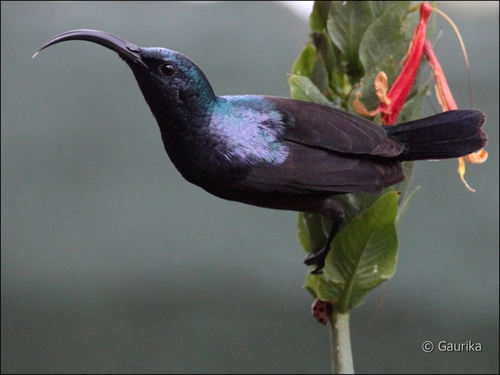
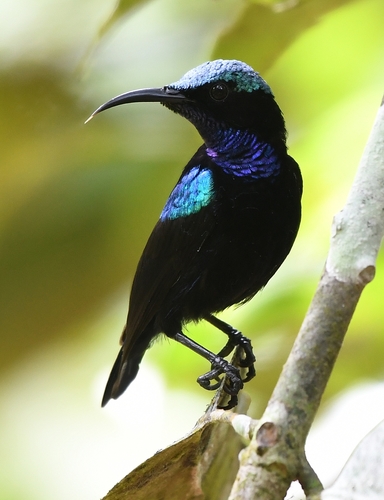
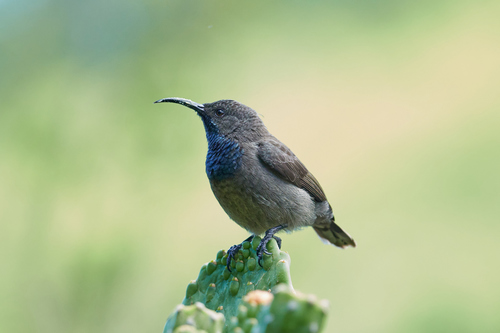
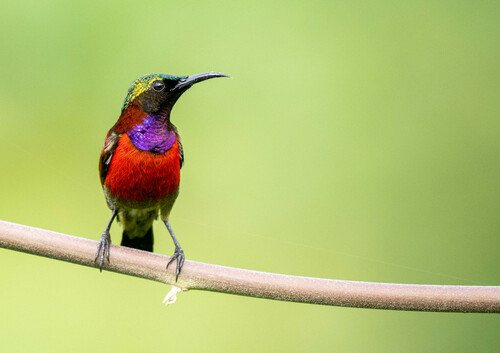
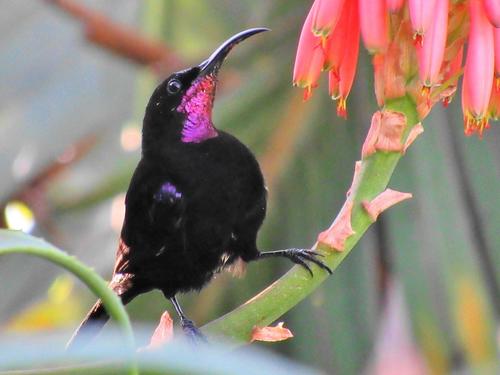
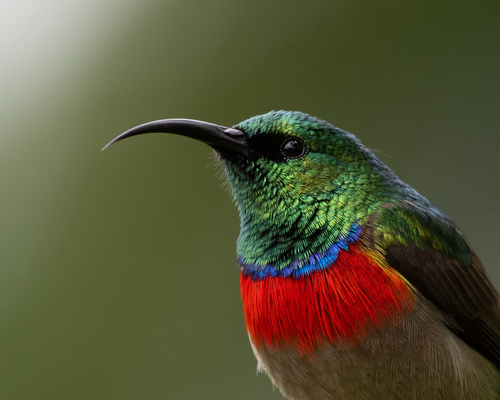
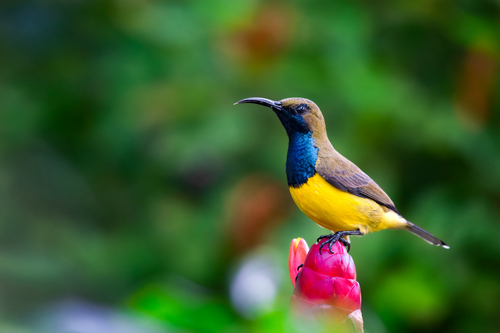
The garden sunbird (Cinnyris jugularis) measures 10 to 11.4 cm (3.9 to 4.5 inches) in total length; males weigh 6.7 to 11.9 g (0.24 to 0.42 oz) and females weigh 6 to 10 g (0.21 to 0.35 oz). For nominate (jugularis) form males, the upper body is an olive shade. Male wing feathers are black with green edges, and the tail is black with white tips. The lores (feathering around the eyes), neck, chin, throat, and breast are dark and iridescent, with yellow pectoral tufts. The lower body is dark yellow, and sometimes a brown band encircles the gorget area. Males have dark brown irises, and their bills and legs are black. Non-breeding males often have glossy black coloration limited to a central throat stripe, which may indicate juvenile birds transitioning to adult plumage. In contrast, females have a greenish olive upper body, with a pale-yellowish stripe above the eyes, yellowish borders on wing feathers, a black-and-white marked tail, and deep yellow lower body that is slightly lighter on the undertail feathers. Juvenile birds resemble females but are generally paler and browner in color. This sunbird is found across the Philippine islands, with the exception of the Palawan archipelago, where the similar Palawan sunbird occurs instead. It lives in forests, shrublands, grasslands, and artificial habitats. It has adapted well to human-altered environments, and is common in fairly densely populated areas, where it builds nests within human settlements. The female garden sunbird constructs the nest from grass, cotton, moss, lichens, leaf fragments, vegetable fibers, and spider webs, and lines the nest with bark or feathers. The nest forms a hanging oval pouch with a sheltered side opening, and often has a dangling "beard" of extra material. Females lay eggs in May and June. Garden sunbirds feed primarily on nectar, but will also eat insects, especially when feeding their young. Most sunbird species can take nectar while hovering, but usually perch to feed for most of the time.