About Cinclus cinclus (Linnaeus, 1758)
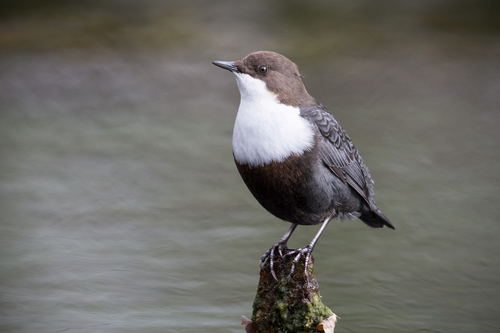
The white-throated dipper, Cinclus cinclus, reaches about 18 centimetres (7.1 in) in length, with a rotund body and short tail. For adults of the gularis and aquaticus subspecies, the head is brown, the back is slate-grey mottled with black that appears black from a distance, and the wings and tail are brown. The throat and upper breast are white, followed by a warm chestnut band that blends into black on the belly and flanks. Its bill is nearly black, while its legs and irises are brown. The nominate subspecies C. c. cinclus has a black belly band. Juvenile white-throated dippers are greyish brown and lack the chestnut band seen in adults. This species is closely tied to swiftly flowing rivers, streams, and the lakes these waterways feed. It often perches on rocks surrounded by swirling, tumbling water, bobbing spasmodically with its short tail held upward. It gets its common name from these sudden dipping movements, not from its diving behavior, although it does both dive and walk into water. Its flight is rapid and straight, with its short wings beating quickly in continuous motion without pauses or glides, and it gives a shrill zil, zil, zil call when flying. After flying, it will either drop onto the water to dive or plunge in with a small splash. From a perch, it can walk into water and submerge deliberately, but the claim that it can walk along the river bottom defying specific gravity is untrue. When it enters water, it does grip the substrate with its strong feet, but it moves beneath the surface by swimming, using its wings to effectively 'fly' underwater. It keeps itself submerged through muscular effort, holding its head low and its body at an oblique angle; its underwater path is often marked by a line of rising bubbles. It catches its food this way, feeding mostly on aquatic invertebrates including caddis worms and other aquatic insect larvae, beetles, Limnaea, Ancylus and other freshwater molluscs, as well as fish and small amphibians. A particularly preferred food is the small amphipod shrimp Gammarus. It also walks and runs along banks and rocks to forage for terrestrial invertebrates. White-throated dippers may be preyed on by predatory fish such as brown trout, though only one predation case has been recorded for this species, unlike the American dipper. The winter habits of the white-throated dipper vary considerably between individuals. When fast hill streams freeze over, the species is forced to move down to lowlands and even visit coasts, though some individuals will stay in place if any open water remains.