About Cinclosoma castanotum Gould, 1840
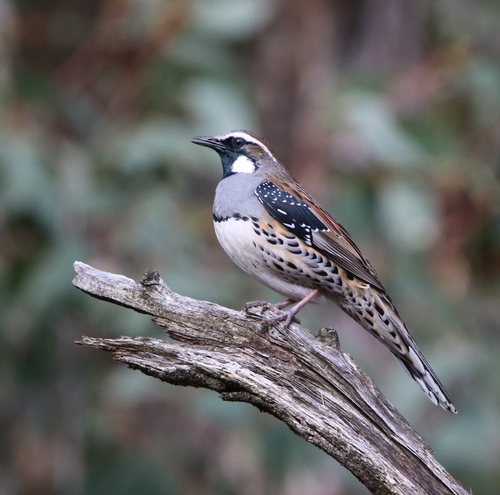
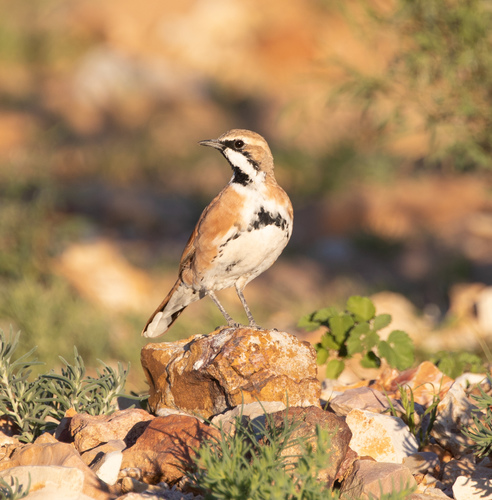
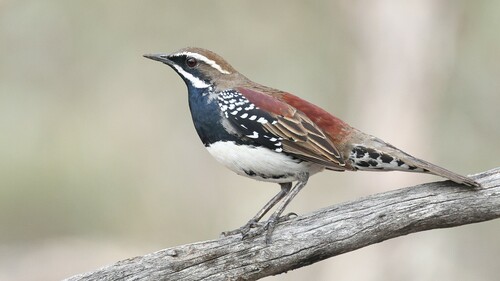
The chestnut quail-thrush (Cinclosoma castanotum Gould, 1840) is a medium-sized bird similar in general appearance to related species Cinclosoma cinnamomeum and C. c. punctatum. It lives in the lower canopy and scrub of arid and semi-arid vegetation. Males have a black breast, grey flanks, chestnut to grey-brown upper parts, a white eyebrow, and a white throat patch. Females differ with a grey throat and breast, rufous and light brown upper parts, and a yellow-buff eyebrow and throat marking, and have an overall duller coloration than males. Both sexes have a white belly. Differences in plumage and body size are an example of the sexual dimorphism common across the Cinclosoma genus. This species gathers in pairs and small family groups, uses scrub and bushes for concealment and as song perches, and runs swiftly in sudden rapid bursts when disturbed or alarmed. It can be identified by its high-pitched call, which sounds like wheit-wheit-wheit or an insect-like see-see see. The chestnut quail-thrush is found across a relatively large area of inland Australia, in both semi-arid and arid landscapes. Its range extends from central Queensland down through western New South Wales, reaching as far south as Cobar. Its distribution and habitats are naturally fragmented by natural landscape breaks that do not support mallee or heathland, leaving no suitable habitat. Its typical habitat is scrub and low-lying vegetation, including mulga-eucalyptus and acacias growing on stony ground, as well as grevilleas and tea trees on rocky hillocks. Habitat preference differs between populations in New South Wales and Western Australia: New South Wales populations occur exclusively in mallee woodlands with spinifex and acacia shrubs, while Western Australian populations occupy understorey habitat in sclerophyll woodlands with acacia shrubs and heathland. Population densities of the species vary in relation to fire regimes; the highest densities occur between 2 and 15 years after fire, while densities drop when fire intervals are shorter than 2 years. The chestnut quail-thrush shares the same breeding season as other quail-thrushes, running from July to December. Males sing starting from daybreak throughout the breeding season. Depending on rainfall, they lay 2 or 3 eggs between August and December. The eggs are cream to white, covered in blackish brown spots. As a ground-nesting bird, it builds its nest in a small shallow depression, using surrounding foliage and local vegetation such as bark, grass, and sticks.