About Cinclocerthia ruficauda (Gould, 1836)
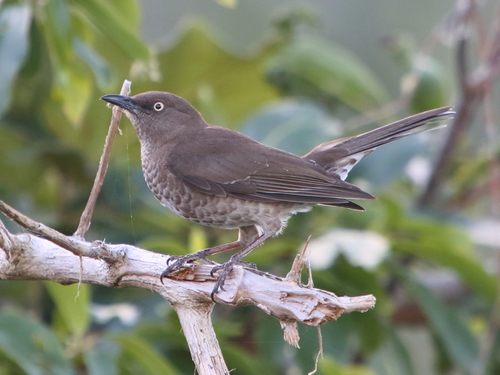
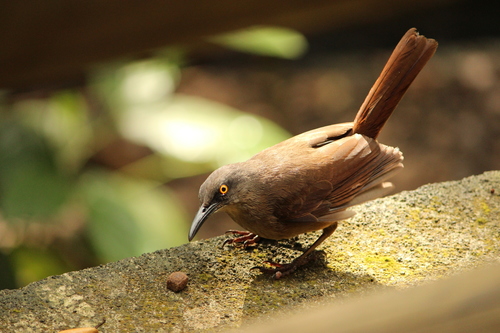
The brown trembler, with the scientific name Cinclocerthia ruficauda (Gould, 1836), has multiple recognized subspecies that vary in size and coloration. The nominate subspecies measures 20.5 to 26 cm (8.1 to 10.2 in) in length. Males of this subspecies weigh between 47.6 to 65.4 g (1.68 to 2.31 oz), while females weigh 42.8 to 71 g (1.51 to 2.50 oz). The species has a long, slightly downward-curved bill, and the female’s bill is longer than the male’s. Adult brown tremblers are primarily covered in various shades of brown. Their crown is a deep grayish brown, the nape is less gray than the crown, their back is an olive brown, and their rump and tail are reddish brown. A blackish stripe runs through the eye on the face, and the cheeks are grayish olive brown. The chin and throat are a pale grayish buff, which darkens to a browner shade on the breast and belly. The sides and flanks are colored cinnamon. Juvenile brown tremblers are similar in appearance to adults, with the addition of faint dusky spots on the breast. Subspecies C. r. pavida is larger than the nominate subspecies, but otherwise similar in appearance. C. r. tenebrosa is also similar to the nominate, but its upperparts are darker and sootier, and its breast is more grayish. C. r. tremula is similar in appearance to C. r. tenebrosa, but is much larger. Each subspecies of brown trembler has a distinct distribution in the Lesser Antilles. C. r. pavida has the widest range of the subspecies, found across the northern Lesser Antilles from Saba south to Montserrat. C. r. tremula is found only on Guadeloupe, the nominate C. r. ruficauda only on Dominica, and C. r. tenebrosa only on St. Vincent. Brown tremblers primarily live in humid evergreen forest, but they also occur in secondary forest and plantations. Their elevation range extends from sea level up to approximately 900 m (2,950 ft).