About Ciliata mustela (Linnaeus, 1758)
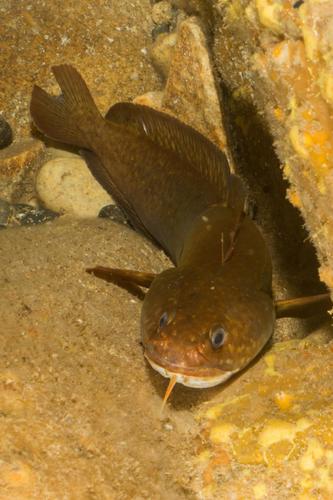
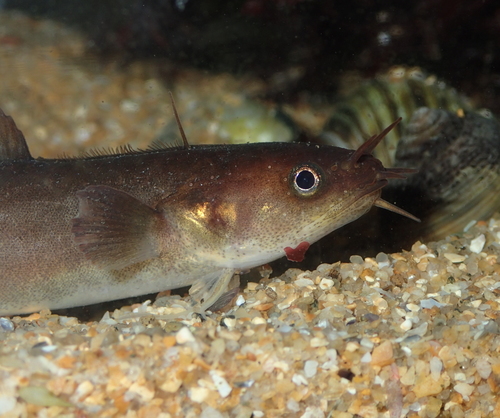
Ciliata mustela, commonly known as the fivebeard rockling, is a long, slender fish that can reach a maximum length of 25 centimetres (9.8 in). It has a smooth, scaleless body and an unusual, long dorsal fin structure: the dorsal fin starts with a single first ray, followed by a line of vibrating rays located in a furrow along the back. No membrane connects the rays of the front portion of the dorsal fin, while the rear dorsal fin runs the full length of the body, and its rays are connected by membrane. The anal fin also runs the entire length of the body, and its rays are connected by membrane. It has five barbels around its mouth: two positioned above each nostril, and one single barbel on the lower jaw. Its mouth is relatively small, with the corners of the mouth extending just past the eye. The fish’s main body color is dark brown, fading to a pale gray-brown on its underside. The fivebeard rockling is distributed in the eastern Atlantic, ranging from Finnmark to Lisbon. This range includes the Skagerrak, the Kattegat, Iceland, and the coastal areas around Great Britain and Ireland. Fivebeard rocklings inhabit the intertidal zone, and are often found under rocks. They most commonly occur in rocky areas, but can also live in breakwater pools on sandy shores as long as these pools support algal growth. This species displays homing behaviour, and is normally found no deeper than the lower limit for the growth of green algae, which is around 20 metres (66 ft). It is a predatory fish; crustaceans make up the majority of its diet, but it also feeds on polychaetes, gastropods, small fish, and has been recorded eating algae. The species tolerates water temperatures ranging from 8 to 24 °C (46 to 75 °F). Individuals of both sexes reach sexual maturity at around one year of age. When spawning, smaller females may lay as few as 9,000 eggs, while the largest females can lay as many as 30,000 eggs. Spawning occurs in deeper Atlantic waters to the west of Ireland, between February and May. The eggs and larvae of this species are pelagic.