About Cigaritis vulcanus
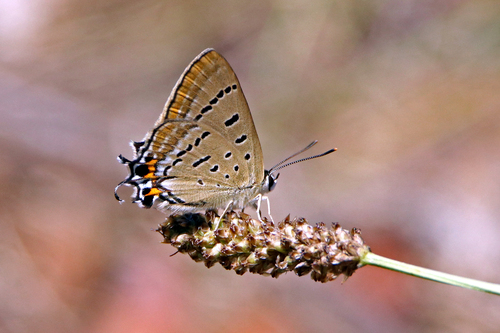
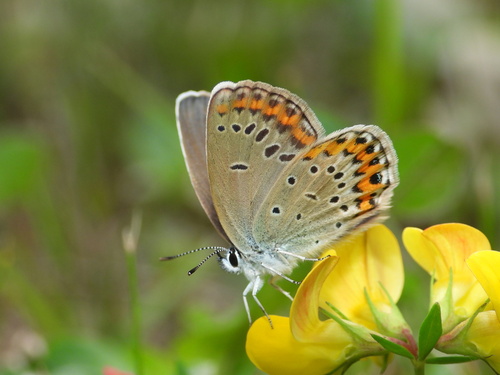
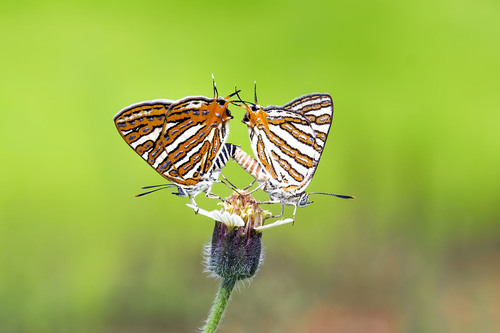
Scientific name: Cigaritis vulcanus. Male description. Upperside dark brown, with a more or less violet tinge. The forewing usually has three short orange-red transverse bands in its upper part. These bands vary in length between individual specimens, and all descend from near the costa downwards; the sub-apical band is the shortest, and the discal band is the longest. Some specimens have an orange-red sub-basal mark, and another on the costa at its middle, plus an indication of a sub-marginal band. The hindwing has an anal orange-red patch, which narrows upwards a short distance sub-marginally in most specimens. There is a small black spot in the anal lobe, and another on the margin between the two tails; both spots have some silvery-blue scales attached. Tails are black, with minute white tips, and the orange-red colour of the anal patch extends halfway up both tails. Both wings have a black outer marginal line and whitish cilia with a black base. Underside is pale whitish-sulphury yellow, with red-brown bands edged with dark brown, and an inner silvery macular lining. The forewing has a thin sub-costal basal streak, a short, club-shaped medial basal streak, and a broad band from the costal fourth to vein 2, with a dark brown mark below it that extends inwards to the base. A medial band, forked upwards above its middle, is outwardly oblique and touches the sub-marginal band. A little above the sub-median vein sits a short sub-apical band composed of two conjoined oval spots, running from the costa to the middle of the interspace below vein 4, where it touches the sub-marginal band. All of these bands have irregular edges. The sub-marginal band, which is narrower than the others, is nearly straight and ends in a diffuse brownish space at the hinder angle. There is also a slightly narrower marginal band that lacks the inner silvery lining. The hindwing has five transverse bands extending from the costa, all ending in the diffuse greyish anal patch. The first is basal, starting in macular form, then curving outwards close to the abdominal margin. The next three run straight down from the costa: sub-basal, medial and discal. The sub-basal band ends in a slightly outwardly curved point that nearly touches the middle band. The discal band joins the curved fifth band at vein 2; this fifth band runs from the apex of the wing in a somewhat recurved form and nearly joins the termination of the middle band. In some specimens the anal patch is somewhat rufous, and in others it is rufous-grey. The anal lobe has a large black spot, there is a somewhat smaller spot on the margin between the two tails, a sub-marginal row of four black lunules extends upwards from the outer tail, and there is a short streak with silvery specks above the anal lobe along and near to the abdominal margin. Antennae are black, with white segmental dots, and the club has a red tip. The frons is white, with a black middle stripe. The head and body, above and below, match the colour of the wings. Female description. Upperside is a duller and paler brown colour. All orange-red bands on the forewing are broader and extend further hindwards, with an additional orange-red macular band close to the outer margin that varies in extent and distinctness between different specimens. On the hindwing, the bands of the underside are often more or less visible through the wing, and the anal orange-red patch extends on each side to form a band that is attenuated upwards close to the outer margin, and usually ends a little above the middle. The underside matches that of the male, but the bands are broader and usually more red. The wingspan of Cigaritis vulcanus is 26–34 mm. Distribution. These butterflies are found in Sri Lanka, India, central Thailand, Vietnam and Java. In India, the species has been recorded in Maharashtra, Orissa, Karnataka, Kerala, Andhra Pradesh, West Bengal, Delhi, Madhya Pradesh, Uttar Pradesh and Tamil Nadu. In Vietnam, this species has only been recorded in Bình Phước province (Monastyrskii, 2003). Habitat. Population numbers of Cigaritis vulcanus peak during the south-west and north-east monsoons. It inhabits scrub land with sparse vegetation, hedge rows, scrub jungles and secondary forest. Food plants. The larvae feed on jujube, Zizyphus rugosa, Ixora longifolia, Clerodendrum siphomanthus, C. inerme, Allophylus cobbe, Ixora chinensis and Canthium parviflorum.