About Cicuta douglasii (DC.) J.M.Coult. & Rose
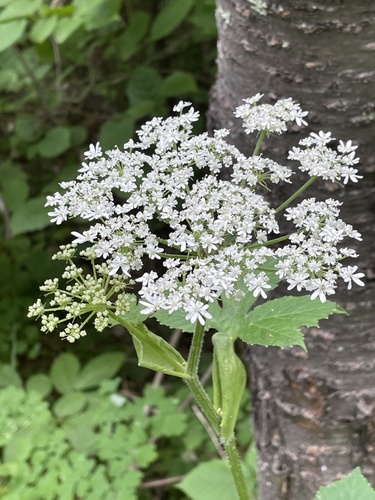
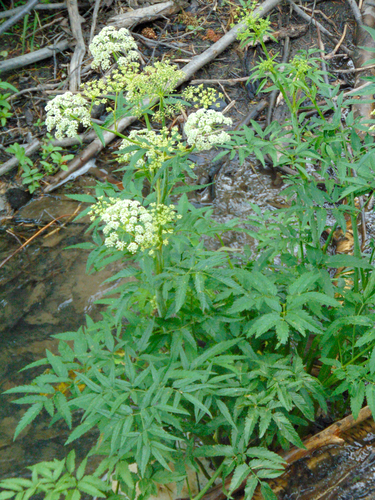
Cicuta douglasii, also known as western water hemlock, has thick, tuberous roots, with many smaller tubers growing from the main tuber; this structure allows the plant to survive in wet conditions. Its stem grows 0.5 to 2 meters (1+1⁄2 to 6+1⁄2 feet) tall and bears purplish spots. Inner tubers and stem bases have horizontal internal chambers that are useful for identification. The leaves are alternate and compound pinnate; the secondary veins of the leaflets end at the bases of leaf teeth rather than at the tips. Leaflets measure 3 to 10 centimeters (1+1⁄4 to 4 inches) long and 1 to 2 centimeters (1⁄2 to 3⁄4 inch) wide, with jagged edges. This species produces inflorescences that are compound umbels about 12.5 centimeters (5 inches) across, holding many small white flowers; each flower produces two seeds. Seeds germinate in spring, and flowers mature in late June to early July. Seeds are dispersed by wind, water, farm machinery, animal and human clothing, and through transported soil. In addition to growing new plants from seeds, rootstocks can also produce new plants in fall from the basal meristem. When these new growths detach the following spring, they can develop into independent new plants. Western water hemlock is indigenous to North America, and is most abundant in British Columbia. It grows primarily from the base of the Rocky Mountains to the Pacific coast, ranging from Alaska all the way to California. This plant’s water requirements prevent it from growing in open rangelands, and it inhabits wet locations including marshes, stream banks, slough margins, ditches, meadows, and wet pastures. The key defining feature of western water hemlock is its toxicity. The plant produces the toxin cicutoxin, which makes it the most poisonous plant in North America. Cicutoxin is a yellowish liquid that is most concentrated in the roots. This unsaturated alcohol has a severe impact on the central nervous system of animals. Early symptoms of cicutoxin poisoning include excessive salivation, frothing at the mouth, nervousness, and incoordination. Symptoms can progress to tremors, muscular weakness, seizures, and respiratory failure. Ingesting green western water hemlock tissue in a quantity equal to roughly 0.1% of a person’s body weight can cause death. In addition to being extremely dangerous to humans, the plant is also highly harmful to animals. Lethal doses by body weight are 0.2–0.5% for sheep, 0.1% for cattle, 0.5% for horses, and 0.3% for swine. Death can occur as quickly as fifteen minutes after ingestion of the toxin. Western water hemlock is one of the first plants to emerge in spring, and has a very pleasant odor. These traits, combined with its growth in moist grazing areas, make it appealing but deadly to grazing animals.