About Cicuta bulbifera L.
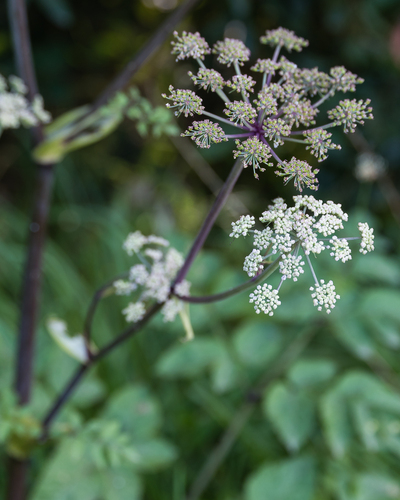
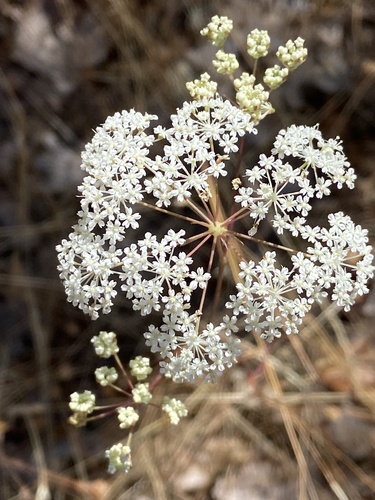
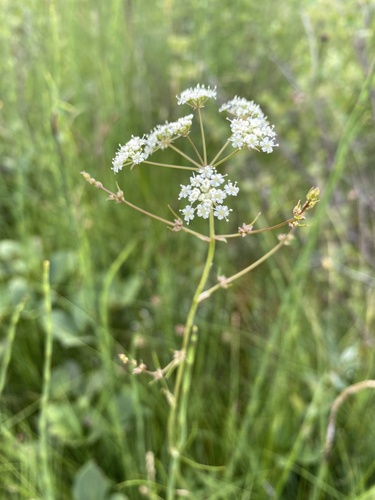
Cicuta bulbifera L. is a perennial herb. This plant grows to 46–107 cm (1.5–3.5 feet) tall, with limited branching. Its stems are light green to slightly reddish, glabrous, and glaucous from epicuticular wax. It produces alternate, compound green leaves that are also glaucous (excluding their petioles). Leaves can reach up to 30 by 15 cm (1 by 0.5 feet), and become smaller as they grow up the stem. Lower leaves are bipinnate, while upper leaves are often simple-pinnate. Lower leaves have long petioles, but petioles on upper shorter leaves are much shorter or even absent. Leaflets (pinnae) grow up to 7.6 cm (3 inches) long and 0.8 cm (0.33 inches) across. They are linear to lanceolate-linear, dentate, and sometimes cleft into narrow lobes. The axils of upper leaves often hold sessile clusters of ovoid bulbils, which can grow into new individual plants. The root system is made up of a cluster of elongated fleshy roots. Stem tips end in compound umbels of small white flowers; each umbel spans about 5.1–10.2 cm (2–4 inches) across, and contains around 8 umbellets, each of which holds approximately 16 flowers. The entire inflorescence is bractless, though a small sessile leaf may grow near its base. Individual flowers are about 3.2 mm (1⁄8 inch) across, and consist of 5 white petals, 5 stamens, 2 styles, and an ovary. Blooming occurs from late summer to early fall, and lasts around one month. The flowers have no noticeable scent. Each seed develops inside a fruit that matches the original flower in size; the fruit is somewhat flattened, egg-shaped, and slightly notched at its apex. Cicuta bulbifera is native to North America, with a broad distribution ranging from Newfoundland and Labrador to British Columbia in Canada, and extending south to Virginia, Indiana, Nebraska, and Oregon in the United States. As a perennial, it reproduces via both seeds and bulbils. It grows along marsh edges and lake margins, in bogs, wet meadows, shallow standing water, and along slow-moving streams. It can also grow on hummocks, floating mats, and partially submerged rotting logs, and has been recorded growing on beaver dams. This species is normally found in high-quality wetlands. All parts of Cicuta bulbifera are highly poisonous to humans and livestock. Tuberous roots, the stem base, and young shoots are especially toxic. Livestock poisoning from water hemlocks is most common in dry areas of the western United States, where grazing animals are drawn to low-lying areas for green forage during dry spells. The poisonous properties of C. bulbifera are similar to those of other species in the genus Cicuta. While roots and rootstalks are the most poisonous parts of the plant, all plant parts appear to contain some amount of poison, particularly during early growth. Ingesting a small portion of the root is enough to kill an adult. Cicuta is often cited as the most poisonous genus of leafy plants native to North America. Cases of poisoning from these plants have been reported multiple times in humans. Both children and adults have mistaken the roots for parsnips or other edible roots, with fatal outcomes in many cases. Most poisoning cases occur in early spring. The amount of C. bulbifera needed to cause death varies with the season and age of the plant. A piece of root about the size of a walnut is enough to kill a cow.