About Ciconia stormi (W.Blasius, 1896)
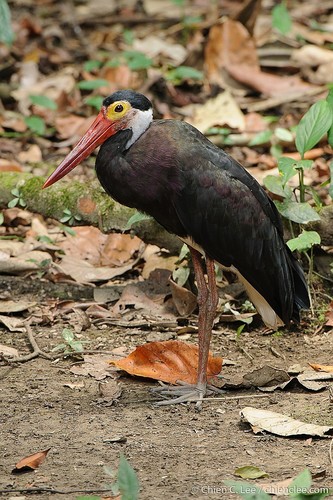
Ciconia stormi, commonly known as Storm's stork, is a medium-sized stork that reaches 75–91 cm in height. Most of its plumage is black, with white undertail coverts and white neck back, and a black cap. It has orange facial skin marked by a yellow ring around the eye, a red iris, and a pinkish-red bill. In some (but not all) males, the bill culmen is slightly concave with a basal knob. Adult legs and feet are dull red, but usually appear paler because they are often covered in the bird's excreta. The bill and other soft body parts darken during the breeding season. Sexes are similar in appearance, but like all storks, males are slightly larger. Field observations also suggest the male's black cap, chest, and throat are slightly glossier. Newly hatched chicks 1–3 days old have completely white down, a black crown, and a black bill with a yellow-orange tip. Their legs, facial skin, and gular pouch are initially light yellow; as chicks age, legs turn pink and facial skin becomes dark grey. The iris is initially brown. Chicks grow very quickly, doubling their birth size in just under a month. By this age, they have started developing black feathers on their wings, throats, and bodies. After 30 days, black feathering extends further, and the black chest and wing coverts are streaked with glossy green and bronze-red. After 45 days, young birds resemble adults, but are smaller, have shorter dark-tipped bills, paler skin, and slightly duller black plumage. Chicks become fully feathered after 52–57 days. Wild young have been reported to leave the nest after approximately 60 days, while captive individuals can typically fly after 90 days.
Outside of the breeding season, adult Storm's storks are generally silent. During the breeding season, they produce vocalizations transcribed as "Kurau". One captive adult has been recorded making quiet sibilant whistling. When parents return to the nest with food, chicks give a relatively loud frog-like begging call.
Most of the global Storm's stork population lives on Borneo, found in Kalimantan (Indonesia), Sarawak, Sabah (Malaysia), and Brunei. It is also found across Sumatra, though it was previously thought to be restricted only to southeastern Sumatra. Though widespread on both islands, the species occurs at low densities; only one or a few individuals are ever seen together, with the largest observed group numbering 12 individuals in Brunei. Smaller populations live in parts of Peninsular Malaysia, where the species is particularly rare. An even smaller population exists in extreme southern Thailand; the species is very unlikely to occur elsewhere in Thailand due to the near absence of remaining suitable habitat. In 1986, the first scientifically documented nest of this species was discovered in southern Thailand. That same year, construction of the Chiew Larn Dam caused extensive flooding that destroyed much of this stork's lowland forest habitat. After the flood, Storm's stork was believed to no longer breed in the area, and was previously considered extinct in Thailand. The species was re-sighted in southern Thailand in 2004 via infrared camera traps, but remains exceptionally uncommon; usually only one individual is sighted at a time even with high-intensity camera trapping. Even so, its persistence in southern Thailand suggests a small breeding population remains there.
Storm's stork primarily inhabits dense lowland riverine forest and peat swamp forest, at altitudes no higher than 240 meters above sea level. In this habitat, the density of large trees (over 10 cm diameter at breast height) ranges from an estimated 500 to 800 trees per hectare. Common tree genera include Dipterocarpus and Ficus. The forest undergrowth is dominated by rattans, bamboos, shrubs, and climbers. Because these habitats are largely inaccessible to humans, data collection on this species is logistically difficult, which may partly explain why little is known about its natural history. While Storm's stork uses both lowland riverine forest and peat swamp forest, it is currently unknown which habitat provides optimal conditions for the species. However, peat swamp forest appears to be an underrecognized ecologically important habitat for the species across most of its range. Following ongoing human-caused loss of lowland riverine forest, peat swamp forest may act as an important refuge for the species, and an extensive area of peat swamp forest exists in West Kalimantan. This habitat is also under threat from conversion to palm oil plantations, logging, and forest fires, so increased conservation efforts should be directed toward protecting peat swamp forest.
The species shows some tolerance of logged forests, but the actual value of these areas as breeding habitat is disputed. Danielsen and Heegaard concluded Storm's stork cannot breed in logged forests despite apparent short-term survival. In any case, current records are too limited to demonstrate that logged forests have long-term value for this species. The species' use of logged forests also comes with caveats: logged forest must have easy access to freshwater margins, and at least 20 years of forest regeneration must pass before the area regains meaningful habitat value. The species' apparent persistence in logged forests may also be explained by a local mosaic of primary and logged forest, as it may rely on undisturbed forest patches as refuges while using logged patches.
Storm's stork is often seen soaring at great heights over rivers and forest clearings, and like many other storks it uses thermals to assist gliding. This soaring behaviour is described as "contagious": when one individual begins to soar, other members of the species join it, forming flocks of up to six individuals. On Borneo, it has also been recorded in open, grassy freshwater swamps and paddy fields. It never uses saline habitats, but occasionally occupies forested inland areas adjacent to tidally influenced bodies of water and near mangrove swamps.
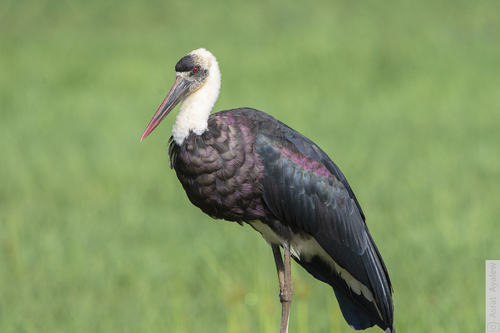
Storm's stork feeds primarily on small fish, frogs, aquatic insect larvae, and sometimes earthworms. These are also the food items that both parents bring back to chicks at the nest; fish brought for chicks measure 5–7 cm long and weigh 10–30 g, while earthworms measure 10–15 cm long. Parents regurgitate food onto the bottom of the nest, and chicks pick up and swallow the food. During 1989 nest observations in southern Sumatra, adults returned to the nest with food for chicks every 2–4 hours in June; in July, food was brought less often, and significantly more frequently in the late afternoon. In Sabah, the species has also been recorded feeding on grasshoppers and possibly crabs. This suggests its diet may be similar to that of the woolly-necked stork, but more data is needed to fully confirm this.
Storm's stork typically forages stealthily with slow, deliberate movements and a retracted neck along muddy river and creek banks in dense primary forest, staying mostly in shaded areas. Individuals with chicks usually forage 2–3 km from the nest. It also uses other freshwater foraging areas with high densities of fish and freshwater invertebrates, including small pools, trackside puddles, swamps, and oxbow lakes. It can use these features most effectively where they occur in a patchwork on riparian floodplains. It may also use boggy clearings created by ungulates such as gaur, which trample vegetation to access mineral licks. The species avoids deep, fast-flowing rivers and waterways due to reduced prey availability and its inability to stand in these waters. In Sabah, it has been found feeding on recently burnt open ground, where it likely catches invertebrates disturbed or killed by fire.