About Ciconia nigra (Linnaeus, 1758)
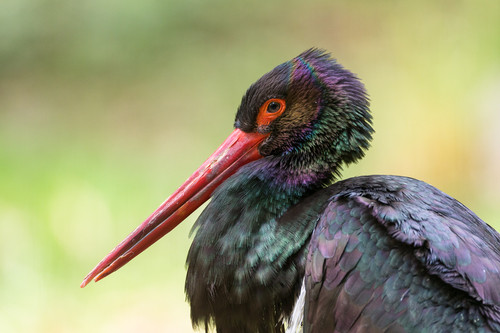
The black stork (Ciconia nigra) is a large bird that measures 95 to 100 cm (37 to 39 in) in length, has a wingspan of 145 to 155 cm (57 to 61 in), and weighs roughly 3 kg (6.6 lb). It can stand up to 102 cm (40 in) tall, and has long red legs, a long neck, and a long, straight, pointed red beak. It shares some resemblance with Abdim's stork (C. abdimii), which can be told apart by its much smaller body, predominantly green bill, legs and feet, and white rump and lower back. The black stork's plumage is black with a purplish green sheen, with the exception of the white lower breast, belly, armpits, axillaries and undertail coverts. Its breast feathers are long and shaggy, forming a ruff that is used during some courtship displays. Black storks have brown irises, and bare red skin surrounding their eyes. Males and females look identical, though males are larger than females on average. Moulting occurs in spring, and new plumage has a brighter iridescent sheen. On the ground, black storks walk slowly and steadily, and like all storks, they fly with their neck outstretched. Juvenile black storks share a similar plumage pattern to adults, but the areas that are black on adult birds are browner and less glossy on juveniles. The scapulars, wing and upper tail coverts have pale tips on juveniles, and their legs, bill and bare eye skin are greyish green. Juvenile black storks could be confused with juvenile yellow-billed storks, but juvenile yellow-billed storks have paler wings and mantle, a longer bill, and white under the wings. During the summer breeding season, black storks are found from Eastern Asia (Siberia and northern China) west to Central Europe. Their breeding range reaches Estonia in the north, and Poland, Lower Saxony and Bavaria in Germany, the Czech Republic, Hungary, Italy and Greece in the south. There is an outlying breeding population in the central-southwestern Iberian Peninsula, covering Extremadura and surrounding provinces of Spain, plus Portugal. The species is migratory, and winters in tropical Africa and Asia, though some populations are sedentary or dispersive. An isolated population lives in Southern Africa, where the species is more numerous in the east, in eastern South Africa and Mozambique; it is also found in Zimbabwe, Eswatini, Botswana, and occurs less commonly in Namibia. Most black storks that breed in Europe migrate to Africa for the winter: storks from western Germany and areas west of there travel south through the Iberian Peninsula, while all other European black storks travel through Turkey and the Levant. Storks that travel via Spain spend winter in the Falémé River basin of eastern Senegal, Guinea, southern Mauritania, Ivory Coast, Sierra Leone and western and central Mali, while storks that travel via the Sinai end up in northern Ethiopia, the Kotto River basin in the Central African Republic, the Mbokou river basin in Chad and northeastern Nigeria. Black storks that breed in West Asia migrate to northern and northeastern India, where they range mainly from Punjab south to Karnataka, and also to Africa. They are occasional visitors to Sri Lanka. Black storks that breed further east in eastern Russia and China winter mainly in southern China, and are occasionally found in Hong Kong, Myanmar, northern Thailand, and Laos. The species was first recorded in western Myanmar in 1998. Compared to the more widely known white stork, the black stork prefers more wooded areas. It breeds in large marshy wetlands with scattered coniferous or broadleaved woodlands, and also lives in hills and mountains that have enough creek networks. It usually lives near ponds, rivers, lake edges, estuaries and other freshwater wetlands. In the Caspian lowlands, the black stork does live in more agricultural areas, but even there it avoids close contact with people. Its wintering habitat in India consists of reservoirs or rivers with nearby scrub or forest that provide trees for black storks to roost in at night. In southern Africa, it is found in shallow water in rivers or lakes, or swamps, but is occasionally seen on dry land. After disappearing from Belgium before the start of the 20th century, the black stork had returned to breed in the Belgian Ardennes, Luxembourg and Burgundy, France, by 2000. Its population appears to be growing in Spain and Portugal, where the population was estimated at 405 to 483 breeding pairs in 2006. The black stork is a rare vagrant to the British Isles, where it appears in warmer months, particularly spring, and is generally found in the south and east. Sightings have become more common since the 1970s, as the species' breeding range shifts northwards. Between 1946 and 1983, it has been recorded in Scotland six times, including from Shetland, Orkney, the Highlands, and Peebles in the Scottish Borders. It is not abundant in the western parts of its range, but lives in higher densities in eastern Transcaucasia. Further east, it has been recorded across Iran, though little is known about its habits there; breeding has been recorded near Aliabad in Fars province, Khabr National Park in Kerman province, Karun river in Khuzestan province, Qaranqu River in East Azarbaijan province, and Aliabad river in Razavi Khorasan province. The black stork population has declined in Iran due to the draining of wetlands. East of the Ural Mountains, the black stork occurs patchily in forested and mountainous areas up to 60°‒63° N across Siberia to the Pacific Ocean. South of Siberia, it breeds in Xinjiang (northwestern China), northern Mongolia south to the Altai Mountains, and northeastern China south to the vicinity of Beijing. On the Korean peninsula, the black stork is an uncommon summer visitor, and has not bred in the south since 1966. Birds have been seen in the northeast, but it is not known if they breed there. Similarly, the black stork has been seen in Afghanistan during the summer, but its breeding status there is uncertain.