About Ciconia microscelis G.R.Gray, 1848
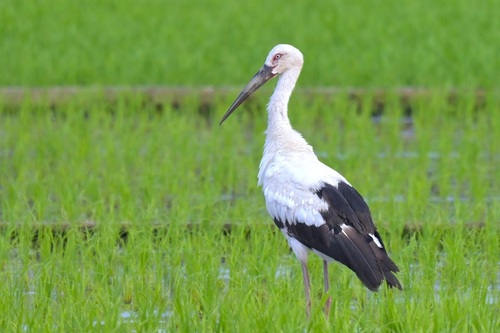
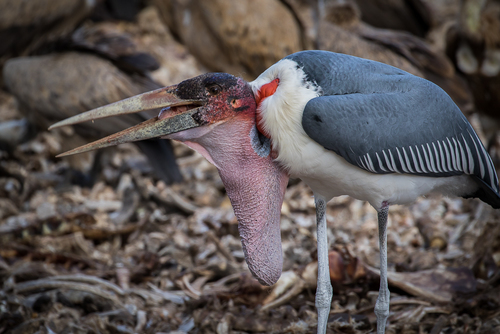
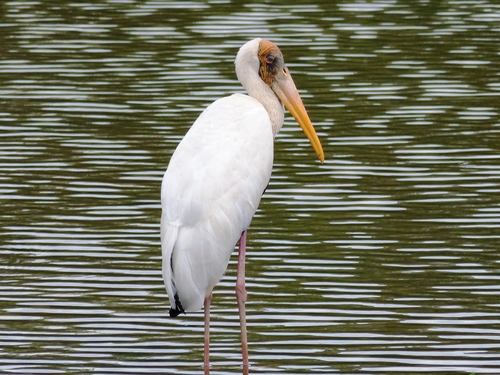
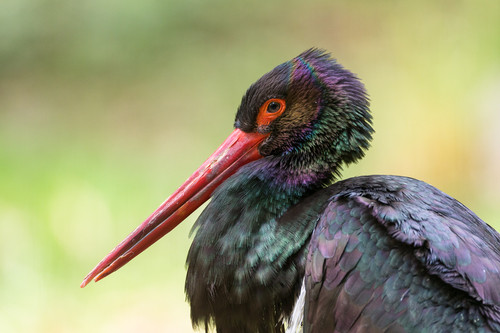
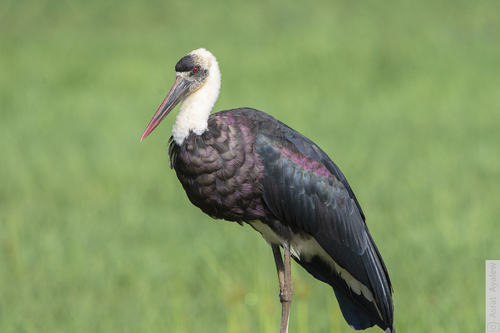
The African woolly-necked stork (scientific name Ciconia microscelis G.R.Gray, 1848) is a medium-sized stork, measuring 75–92 cm in height. Its iris is deep crimson or wine-red. Overall, the stork has glistening black plumage, with a black 'skull cap' and a downy white neck that gives the species its common name. The lower belly and under-tail coverts are white, which contrasts sharply with the rest of its dark plumage. Feathers on the fore-neck are iridescent with a coppery-purple tinge; these feathers are elongated and can be erected during breeding displays. Its tail is deeply forked and white, and is usually covered by long black under tail coverts. It has long red legs and a heavy, blackish bill, though some specimens have mostly dark-red bills with only the basal one-third of the bill being black. The plumage of male and female African woolly-necked storks is identical, though males are thought to be larger. Juvenile birds are duller in color than adults, and have a feathered forehead that is sometimes streaked black-and-white. Compared to Asian woolly-necked storks, which have a sharp, clean border to their black cap, African populations have a diffused or jagged border to the edge of the black cap. When the wings are opened — either during displays or for flight — a narrow band of very bright unfeathered skin is visible along the underside of the forearm. This band has been described variously as 'neon, orange-red', 'like a red-gold jewel', and 'almost glowing' when seen at close range. Small nestlings are pale grey with buffy down on the neck, and a black crown. By fledging age, immature birds are nearly identical to adults, except they still have a feathered forehead, much less iridescence on their feathers, and much longer, fluffier neck feathers. Newly fledged young have a prominent white mark in the center of the forehead that can be used to identify young of the year. This is a widespread tropical resident breeding species, that breeds across much of western, eastern and south-central Africa. It builds nests on trees located in agricultural fields or wetlands, on natural cliffs, and on cell phone towers. It uses a variety of freshwater habitats, including seasonal and perennial reservoirs, marshes, crop lands, irrigation canals and rivers. It is attracted to fires in grasslands and crop fields, where it catches insects escaping the fire. It also uses ponds and marshes inside forests across its African range. It uses coastal areas in Africa as well; birds on the Kenya coast forage in coral reefs and mudflats. In KwaZulu Natal, South Africa, the storks are accustomed to being fed by people, and nest on non-native tree species in suburban areas.