About Ciconia episcopus (Boddaert, 1783)
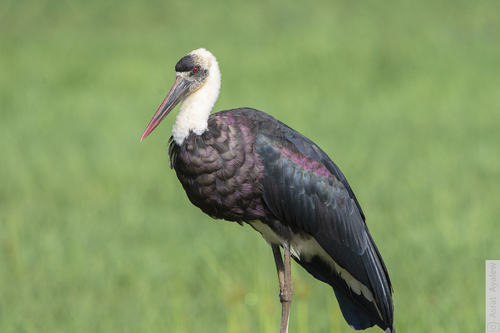
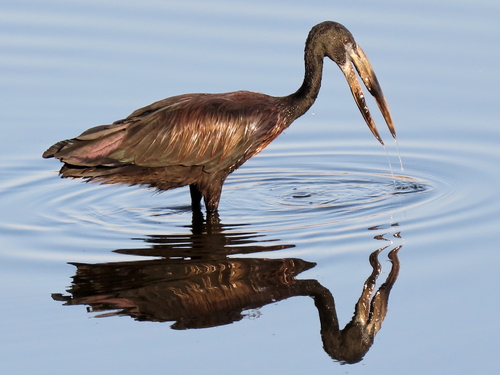
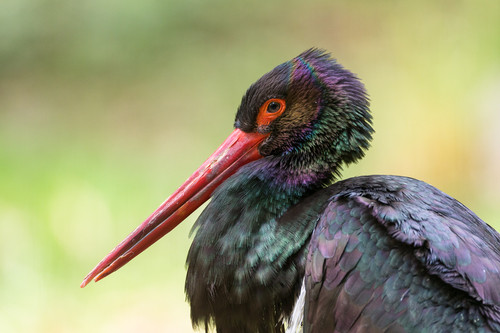
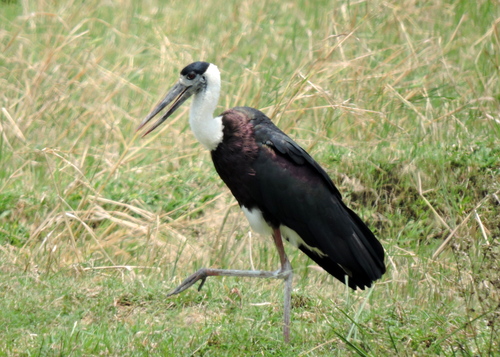
The woolly-necked stork, scientifically named Ciconia episcopus (Boddaert, 1783), is a medium-sized stork that reaches 75–95 cm in height. Its iris is deep crimson or wine-red. Overall, the stork has glistening black plumage with a black 'skull cap' and a downy white neck, which gives the species its common name. The lower belly and under-tail coverts are white, standing out against the rest of the dark plumage. Feathers on the fore-neck are iridescent with a coppery-purple tinge; these feathers are elongated and can be erected during breeding displays. The tail is deeply forked and white, though it is usually covered by the long black under tail coverts. It has long red legs and a heavy, blackish bill, though some specimens have mostly dark-red bills with only the basal one-third being black. Male and female woolly-necked storks look identical to one another, though males are thought to be larger on average. Juvenile birds are duller in color than adults, with a feathered forehead that is sometimes streaked black-and-white. African populations of this stork are described as having a diffused or jagged border to the black cap, while Asian populations have a sharp, clean border to the cap. When the wings are opened, either during displays or for flight, a narrow band of very bright unfeathered skin is visible along the underside of the forearm. This band has been variously described as "neon, orange-red", "like a red-gold jewel", and "almost glowing" when seen at close range. Small nestlings are pale grey with buffy down on the neck and a black crown. By fledging age, immature birds are identical to adults except for their feathered forehead, much weaker iridescence on feathers, and much longer, fluffier neck feathers. Newly fledged young have a prominent white mark in the center of the forehead that can be used to identify young of the year. Common English names for this species include the white-necked stork, white-headed stork, bishop stork and parson-bird. More recently, the African and Asian populations have been considered two separate species: the African woolly-necked stork and the Asian woolly-necked stork. This proposed split is based purely on geographical isolation, and there is currently no morphological or phylogenetic evidence to support it. This is a widespread tropical species that breeds in Asia, from India to Indonesia. It is a resident breeder that builds nests on trees in agricultural fields or wetlands, on natural cliffs, and on cell phone towers. The species uses a variety of freshwater habitats including seasonal and perennial reservoirs, marshes, crop lands, irrigation canals and rivers. Across south Asia and Myanmar, woolly-necked storks are mostly found in agricultural areas and in wetlands located outside of protected areas. They are attracted to fires in grasslands and crop fields, where they catch insects that are fleeing the fire. In Asia, particularly southeast Asia, they use ponds and marshes inside forests, and also use grassy and marshy areas in clearings across multiple forest types. In India, the species is uncommon in coastal habitats, though it does use coastal areas elsewhere in Asia; birds in Sulawesi have been observed eating sea snakes. In an agricultural landscape in northern India, woolly-necked storks preferred fallow fields during the summer and monsoon seasons, and natural freshwater wetlands during the winter. In this area, irrigation canals were preferentially used during winters when water levels were low, and birds avoided crop fields in all seasons. Assisted by the construction of new irrigation canals, the species is spreading into arid areas such as the Thar Desert in Rajasthan, India. Across south Asia, Asian woolly-necked storks mostly use agricultural landscapes, with greater numbers found using unprotected wetlands than would be expected based on the total amount of wetlands in the landscape, and a majority of individuals use agricultural crop areas. In Haryana, northern India, they nest on trees planted along crop fields and irrigation canals as part of traditional multifunctional agroforestry, and generally avoid trees located close to human settlements. Individuals of this species have been recorded at altitudes of 3,790 m above sea level at Napahai wetland in China, and 3,540 m above sea level in the Annapurna Conservation Area in Nepal.