About Ciconia ciconia (Linnaeus, 1758)
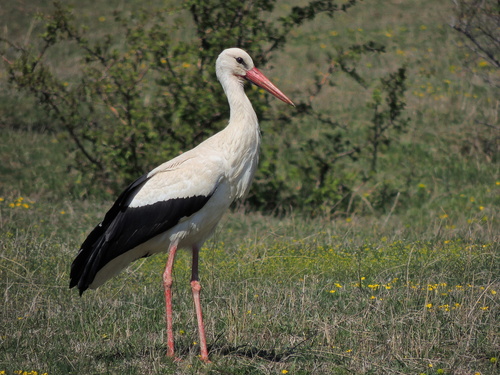
The white stork (Ciconia ciconia) is a large bird. It measures 100–115 cm (39–45 in) in length, has a standing height of 100–125 cm (39–49 in), a wingspan of 155–215 cm (61–85 in), and weighs 2.3–4.5 kg (5.1–9.9 lb). Like all storks, it has long legs, a long neck, and a long straight pointed beak. The sexes look identical, though males are larger than females on average. Its plumage is mostly white, with black flight feathers and wing coverts; the black color comes from the pigment melanin. Its long, shaggy breast feathers form a ruff that is used in some courtship displays. The irises are dull brown or grey, and the peri-orbital skin is black. Adult white storks have bright red beaks and red legs; this color comes from carotenoids in their diet. Studies in parts of Spain have found the pigment comes from astaxanthin obtained from the introduced crayfish species Procambarus clarkii, and bright red beak color appears even in nestlings there, unlike the duller beaks of young white storks elsewhere. Like other storks, white storks have long broad wings that allow them to soar. When flapping during flight, their wingbeats are slow and regular. They fly with their neck stretched forward and their long legs extended well beyond the end of their short tail. They walk at a slow steady pace with their neck held upright, but often hunch their head between their shoulders when resting. Moulting has not been extensively studied, but it appears to occur throughout the year, with primary flight feathers replaced during the breeding season. When newly hatched, young white storks are partially covered with short, sparse, whitish down feathers. This early down is replaced about a week later by a denser coat of woolly white down. By three weeks old, young birds develop black scapulars and flight feathers. Hatchlings have pinkish legs that turn greyish-black as they age, and their beak is black with a brownish tip. By the time they fledge, juvenile plumage is similar to adult plumage, though their black feathers often have a brown tinge, and their beak and legs are a duller brownish-red or orange. Their beak is typically orange or red with a darker tip. Juvenile bills gain the adult red color the following summer, though black tips persist on some individuals. Young storks develop full adult plumage by their second summer. The nominate race of the white stork has a wide but disjunct summer breeding range across Europe: it is clustered in the Iberian Peninsula and North Africa in the west, across much of eastern and central Europe (with 25% of the global population concentrated in Poland), and also occurs in parts of western Asia. The asiatica subspecies, which numbers around 1450 birds, is restricted to a region in central Asia between the Aral Sea and Xinjiang in western China; the Xinjiang population is believed to have gone extinct around 1980. Migration routes extend the species' range into many parts of Africa and India. Some populations follow the eastern migration route, which crosses Israel into eastern and central Africa. In Africa, white storks may spend the winter in Tunisia, Morocco, Uganda, Angola, Zimbabwe, Djibouti, Botswana, Mozambique, Zambia, Eswatini, Gambia, Guinea, Algeria, and Ghana. A few breeding records from South Africa have been known since 1933 at Calitzdorp, and around 10 birds have been recorded breeding around Bredasdorp since the 1990s. A small population of white storks winters in India, and is thought to come mostly from the C. c. asiatica population, since flocks of up to 200 birds were observed on spring migration through the Kurram Valley in the early 1900s. However, birds ringed in Germany have also been recovered in western (Bikaner) and southern (Tirunelveli) India. One atypical specimen with red orbital skin, a trait of the Oriental white stork, has been recorded, so further study of the Indian population is needed. North of the breeding range, the white stork is a passage migrant or vagrant in Finland, Iceland, Ireland, Norway, and Sweden, and as far west as the Azores and Madeira. Despite their proximity, the species is rare in Finland, while Estonia has an estimated 5,000 breeding pairs. In recent years, the species' range has expanded into western Russia. The white stork's preferred feeding grounds are grassy meadows, farmland, and shallow wetlands. It avoids areas overgrown with tall grass and shrubs. In the Chernobyl area of northern Ukraine, white stork populations declined after the 1986 nuclear accident, as farmland became overgrown with tall grass and shrubs. In parts of Poland, poor natural foraging conditions have forced birds to look for food at rubbish dumps since 1999. White storks have also been reported foraging at rubbish dumps in the Middle East, North Africa, and South Africa. Anthropogenic litter was found in the pellets of one third of breeding pairs in Poland, even though all these pairs nested far from major dumps and landfills. The white stork breeds in greater numbers in areas with open grasslands, particularly grassy areas that are wet or periodically flooded, and breeds less often in areas with taller vegetation such as forest and shrubland. They use grasslands, wetlands, and farmland on their African wintering grounds. White storks were probably helped by human activities during the Middle Ages, when woodland was cleared to create new pastures and farmland, and they spread across much of Europe, breeding as far north as Sweden. The Swedish population is believed to have become established in the 16th century, after forests were cleared for agriculture. Approximately 5,000 breeding pairs were estimated to live in Sweden in the 18th century, but the population declined after that. The first accurate census in 1917 recorded 25 pairs, and the last pair failed to breed around 1955. A similar pattern occurred in Denmark: the white stork became established there in the 15th century, when forests were replaced by farmland and meadows, then the population grew rapidly over the following centuries before declining quickly over the last 200 years, mainly due to modern high-intensity agriculture. The white stork has been a rare visitor to the British Isles, with about 20 birds seen in Britain each year, and before 2020 there were no nesting records since a pair nested atop St Giles High Kirk in Edinburgh, Scotland, in 1416. In 2020, a pair bred in the United Kingdom for the first time in over 600 years, as part of a reintroduction initiative in West Sussex called the White Stork Project. A global population decline began in the 19th century due to industrialization and changes in agricultural methods. White storks no longer nest in many countries, and the current strongholds of the western population are Portugal, Spain, Ukraine, and Poland. In the Iberian Peninsula, populations are concentrated in the southwest, and have also declined due to agricultural practices. A 2005 published study found that the Podhale region in the uplands of southern Poland has seen an influx of white storks, which first bred there in 1931 and have nested at progressively higher altitudes since, reaching 890 m (3000 ft) in 1999. The study authors proposed this shift is related to climate warming and the movement of other animals and plants to higher altitudes. White storks arriving to breed in spring in Poznań province (Greater Poland Voivodeship) in western Poland arrived around 10 days earlier in the last twenty years of the 20th century than they did at the end of the 19th century.