About Cichorium intybus L.
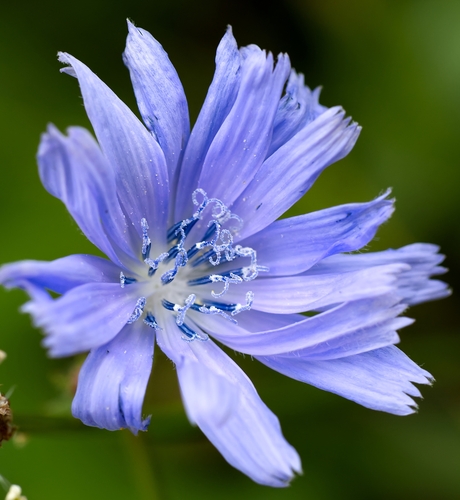
When flowering, Cichorium intybus (chicory) has a tough, grooved stem that is more or less hairy, and can grow up to 1.5 metres (5 feet) tall. Its leaves are stalked, lanceolate, and unlobed; they measure 7.5–32 centimetres (3–12+1⁄2 inches) long (with the smallest leaves found near the top of the stem) and 2–8 cm (3⁄4–3+1⁄4 in) wide. The plant's flower heads are 3–5 cm (1+1⁄4–2 in) wide, and are usually light blue or lavender; white or pink flowers have been rarely reported. Chicory has two rows of involucral bracts: the inner row is longer and erect, while the outer row is shorter and spreading. It flowers from March through October. Its seeds have small scales at the tip. The plant's characteristic bitterness comes primarily from two sesquiterpene lactones: lactucin and lactucopicrin. Other chemical components found in chicory include aesculetin, aesculin, cichoriin, umbelliferone, scopoletin, 6,7-dihydrocoumarin, plus additional sesquiterpene lactones and their glycosides. Around 1970, researchers discovered that chicory root contains up to 20% inulin, a polysaccharide similar to starch. Chicory is native to western Asia, North Africa, and Europe. It grows as a wild plant along roadsides in Europe. Early European colonists brought chicory to North America. It is also common and has become widely naturalized in China and Australia. It grows more abundantly in areas with high rainfall. Chicory is both a cultivated crop and a weedy plant with a cosmopolitan distribution. Analysis of introduced weedy chicory populations in North America shows that naturalized weedy chicory is partially descended from domesticated cultivars. It grows in roadsides, waste places, and other disturbed areas, and can survive in lawns because it is able to resprout from its low basal rosette of leaves. It does not typically spread into undisturbed natural areas. It grows best on limestone soils, but is tolerant of a wide range of other conditions. Bees, butterflies, and flies feed on the plant, and chicory is classified as drought tolerant. Chicory root contains essential oils similar to those found in plants of the related genus Tanacetum. In alternative medicine, chicory is one of the 38 plants used to make Bach flower remedies.