About Cichlasoma bimaculatum (Linnaeus, 1758)
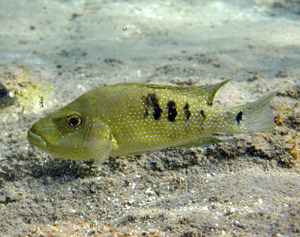
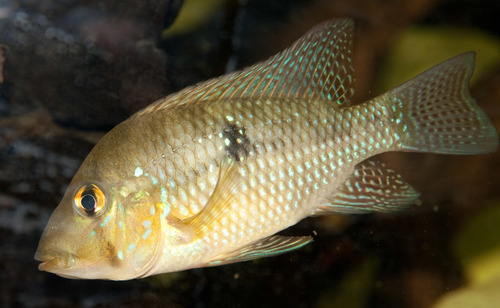
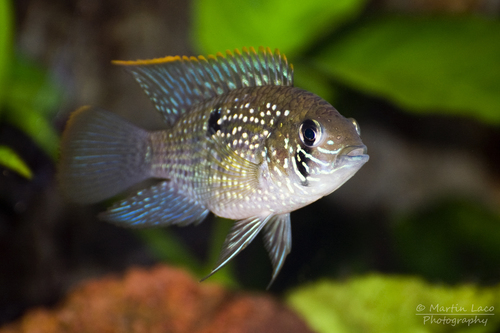
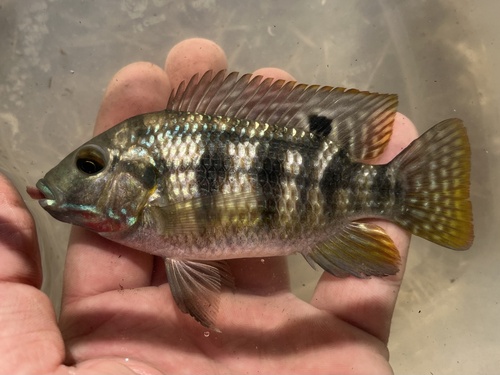
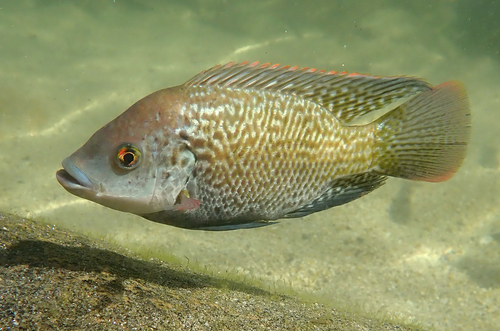
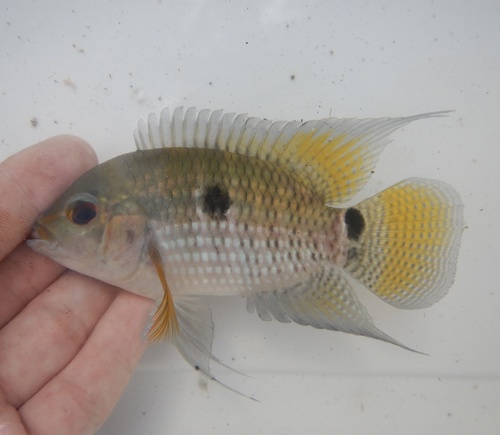
Cichlasoma bimaculatum, commonly called the black acara, has a set of distinguishable physical traits. Its back ranges from dark beige to gray, with a dirty white underbelly. It has a stout forebody, a more compressed posterior body, and an overall oval to slightly rectangular shape. Its body (base tone beige to gray) has an asymmetrically spotted caudal fin and four anal spines. A black to green-gray stripe runs from the eye through a mid-lateral spot, and continues to a black spot at the base of the upper caudal fin. A dark blotch sits below the eye, and this species has a small, terminal mouth. Narrow, even black rimming runs along the edges of its scales, though this feature may be absent in some individuals. Black acara only display bright coloring when they live or are held in optimal conditions, such as the wild or properly maintained aquariums. Individuals held in unsuitable conditions or exposed to traumatic events often appear very pale. While details of sexual dimorphism in this species are conflicting, females are typically more plump than males and have a visible ovipositor. Males have more tapering body shapes and a straight belly during spawning. Black acara commonly occupy shallow, stagnant roadside ditches or similar disturbed habitats that normally support few other fish species. They are also frequently found in larger canals and lakes. This species does not live solitarily; it typically occurs in pairs or groups. Both parents guard their young until the young reach sexual maturity, which occurs when they grow to about four inches in size. This species reaches a maximum size of around eight inches, and can weigh up to about four ounces. An average spawning event produces roughly 1,000 eggs. Studies of deceased black acara have examined their stomach contents: half of the examined stomachs contained aquatic insects, plant material, snails, and detritus. The first reported introduction of Cichlasoma bimaculatum to a new non-native range was in Florida in 1965. Florida is the only U.S. state with a reported nonindigenous occurrence of this fish, with confirmed sightings in Big Cypress Swamp, the Everglades, and Lake Okeechobee. The species can also be found in creeks, canals, drainage ditches, and wet prairies. Factors that support the black acara’s successful establishment in Florida include warm waters, and slow water current in some areas. To avoid predation, black acara prefer habitats such as lakes and canals with rocky bottoms that let them blend into their surroundings. Their successful spread across Florida is also aided by their year-round breeding cycle, ability to tolerate low oxygen levels, and high fecundity. Unlike chanchita, the tropical black acara is native to equatorial South America. While the two species look extremely similar, the subtropical chanchita does not inhabit waters north of southern Brazil. Researchers note that chanchita is more cold-tolerant, so it could become more widespread in Florida than the black acara and may threaten native plants in North Central Florida habitats. In Florida, black acara currently occupy seven different counties and five other river drainages, well beyond the original Tampa Bay drainage where the species was first introduced. Black acara typically spawn on flat surfaces, such as logs, gravel, and broad-leaved rigid plants; in aquariums, they may spawn on the aquarium glass. The female lays eggs, and the male fertilizes them shortly after laying. The spawning pair then cares for the nest: they oxygenate the eggs, remove unfertilized eggs or eggs invaded by fungus, and drive away any approaching predators. For home aquariums, a separate tank is recommended for breeding to reduce tension among other tank inhabitants. The eggs hatch in roughly 24 to 48 hours. For the first 3 to 5 days after hatching, the fry feed on their yolk sac, and begin swimming close to their parents by the end of this period. After this stage, young black acara can be fed live food sized appropriately for their age, such as artemia nauplii, shelled artemia larvae, infusoria, and specially formulated rations for oviparous fry. Young fish typically isolate themselves from their parents around one month after birth, though isolation will happen as soon as parents and young stop showing interest in one another.