About Cichla ocellaris Bloch & Schneider, 1801
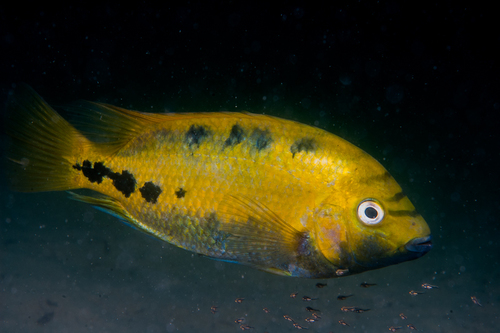
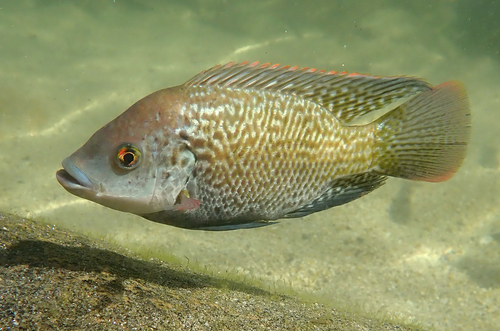
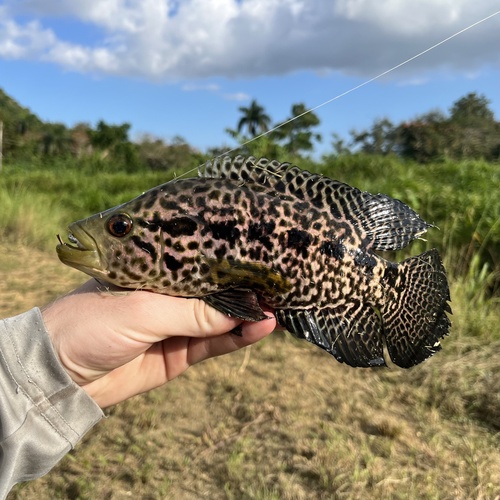
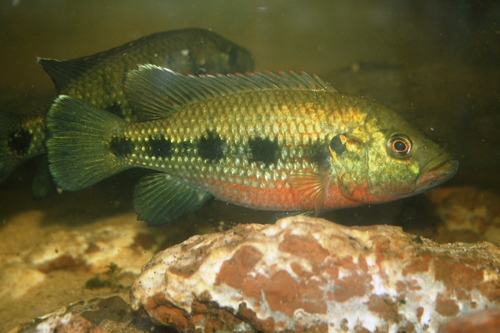
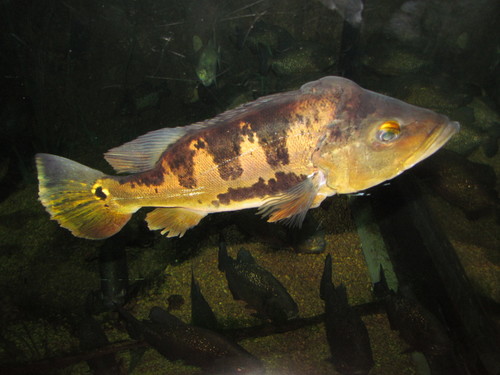
Appearance and identification: The butterfly peacock bass (Cichla ocellaris) has a similar body shape to the largemouth bass. It can reach a maximum length of 29 inches (740 mm), with an average length of 12–14 inches (300–360 mm). Its body and fin colors range across yellows, greens, light red and orange, and overall coloration is extremely variable. The most prominent identifying feature is three vertical black lines along the sides of the body. These lines often fade with age, and may be completely absent in some older individuals. The species' common name comes from a black spot surrounded by a yellow halo on its caudal fin, which resembles the feather markings of a peacock. Origins and habitat: This species is native to tropical Americas, where true Cichla ocellaris populations are restricted to the Guianas. It thrives in warm, slow-moving water bodies including lakes, ponds, canals and rock pits. Like other bass species, it tends to occupy shaded areas under trees, bridges and culverts. Butterfly peacock bass cannot survive in water with salinities over 18 ppt, nor in water temperatures below 60 degrees Fahrenheit. Current distribution: In 1984, the Florida Fish and Game Commission introduced this species to the lakes and rivers of Miami-Dade County in south Florida. Roughly 10,000 juvenile fish were released into local lakes and canals during this introduction. The species spread through the region's warm freshwater canals, and is thought to occupy up to 300 miles (500 km) of canals specifically. Because it cannot tolerate salt water and low water temperatures, it is typically found only in Miami-Dade and Broward County, Florida, with a small number of sightings recorded in Texas and Louisiana. Large populations of this species have also been introduced to Trị An Lake in Vietnam.