About Cicerbita alpina (L.) Wallr.
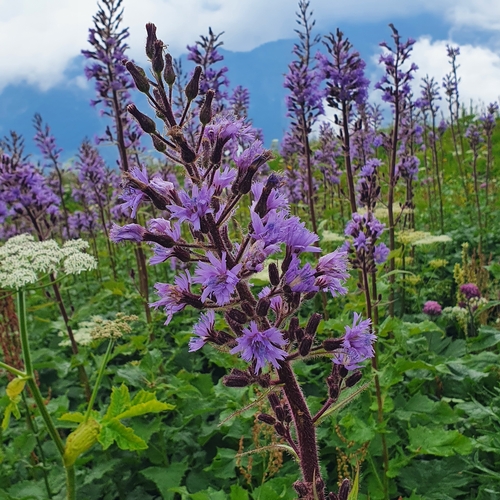
Cicerbita alpina (L.) Wallr. averages 80 centimeters (31 inches) in height, ranging from a minimum of 50 cm (20 in) to a maximum of 150 cm (59 in). Its stem is erect, usually unbranched, covered in glandular hairs, and contains a white milky latex. Its alternate leaves are broad, triangular, and clasp the stem; they are bluish-grey on the underside, hairy along the veins, and have toothed margins. The plant forms an inflorescence structured as a panicle. Each composite flower is roughly 2.5 cm (1 in) wide, held within a whorl of bracts. Individual florets are blue-violet and tongue-shaped, with a toothed, truncated tip; each floret has five stamens and a fused carpel. All florets on Cicerbita alpina are ray florets, with no disc florets present. Its seeds are covered in unbranched hairs. In the temperate northern hemisphere, the flowering period runs from June to September. Cicerbita alpina grows across many mountain ranges in Europe, including the Alps, the Pyrenees, the northern Apennines, the Scandinavian Peninsula, Scotland, the Carpathians, and the Urals. In Scotland, the species is endangered and only occurs in four known locations. It grows in alpine woods, alongside streams, in hollows with rich soil, and in tall meadows, most commonly between 1,000 and 1,800 metres (3,280 and 5,910 ft) above sea level. In Finland, this species is called "bear-hay" because Eurasian brown bears feed on it; elk and reindeer also feed on the plant. Occasionally, people use the plant for food, eating it raw or cooked in reindeer milk.